Keynote/Plenary Talks
Discover insights from leading experts, keynote speakers, and distinguished guests as they share cutting-edge research, industry trends, and visionary ideas. These sessions are designed to inspire and engage participants across all areas of the conference.
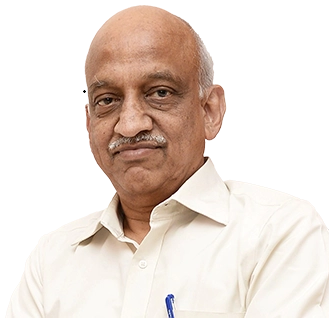
Padma Shri A. S. Kiran Kumar
Former Chairman, ISRO
Former Secretary, Department of Space, Govt. of India; Former Director, Space Applications Centre (SAC), ISRO ; Vikram Sarabhai Professor, ISRO; Chairman, Physical Research Laboratory Management Council and Member, Space Commission, Government of India
Keynote Topic
India’s Journey to the Moon and Its Impact on Future Space Exploration
08-09-2026 10:30 AM - 11:30 AM Auditorium
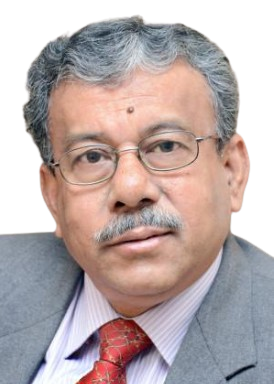
Keynote Topic
Granular Computing and Deep Learning: Video Analytics and Z-numbers
09-09-2026 11:45 AM - 12:45 PM LT-1
Abstract
India’s Journey to the Moon and Its Impact on Future Space Exploration
Lunar exploration missions of India have enhanced scientific understanding of the Moon’s surface composition, thermal characteristics, seismic activity, plasma environment, and near-surface conditions. They have also contributed to the development of critical capabilities in spacecraft navigation, propulsion, deep-space communication, autonomous landing, rover operations, and in situ scientific experimentation.
The knowledge, experience, and technological capabilities gained through the Chandrayaan programme are expected to influence India’s future missions to the Moon and beyond. Theyprovide a foundation for advanced lunar research, sample-return missions, international scientific collaboration, exploration of lunar resources, and future human lunar exploration. India’s journey to the Moon is therefore not only a significant national achievement but also an important contribution to humanity’s continuing exploration of space and an inspiration for future generations of scientists and engineers.
The knowledge, experience, and technological capabilities gained through the Chandrayaan programme are expected to influence India’s future missions to the Moon and beyond. Theyprovide a foundation for advanced lunar research, sample-return missions, international scientific collaboration, exploration of lunar resources, and future human lunar exploration. India’s journey to the Moon is therefore not only a significant national achievement but also an important contribution to humanity’s continuing exploration of space and an inspiration for future generations of scientists and engineers.
Biography
Padma Shri A. S. Kiran Kumar
Former Chairman, ISRO, Former Secretary, Department of Space, Govt. of India; Former Director, Space Applications Centre (SAC), ISRO ; Vikram Sarabhai Professor, ISRO; Chairman, Physical Research Laboratory Management Council and Member, Space Commission, Government of IndiaShri A. S. Kiran Kumar is Chairman, Physical Research Laboratory Management Council and Member, Space Commission, Govt of India.
He has served as Secretary, Department of Space and Chairman, Indian Space Research Organisation, during 2015-2018.
Shri Kiran Kumar, born on October 22, 1952 in Hassan, Karnataka, holds M.Sc. Degree in Physics (Electronics) from Bangalore University and M.Tech. Degree in Physical Engineering from Indian Institute of Science, Bangalore.
He has steered the implementation of the applications oriented Indian Space Programme, which has facilitated rapid development of the country in many important spheres of earth observation, communication, navigation, meteorology and space science, as well as the development of indigenous launch vehicles and related technologies for providing assured access to space. He has led design and development of more than 50 Electro-Optical Imaging Sensors flown on various Space borne platforms starting from Bhaskara in 1979. Further, his role in the success of Chandrayaan missions and Mars Orbiter Mission has been significant.
Shri Kiran Kumar has been the Chair of the Committee on Earth Observation Satellites (CEOS) in 2012. He has made valuable contributions to Coordination Group of Meteorological Satellites (CGMS), Expert Team on Satellite Systems – World Meteorological Organisation (ETSAT of WMO) and Indo-US Joint Working Group on Civil Space Cooperation.
Shri Kiran Kumar has been the President, Aeronautical Society of India. He is Fellow of Indian National Academy of Engineering, National Academy of Sciences India, Indian Society of Remote Sensing, Institution of Electronics & Telecommunications Engineers, Indian Society of Systems for Science & Engineering, Indian Meteorological Society, Indian Society of Geomatics, Gujarat Science Academy, Andhra Pradesh Akademi of Sciences and an elected member of International Academy of Astronautics. He has been conferred with Honoris Causa and DSc by 18 Indian academic institutions.
He has co-authored 85 publications in various national/international scientific journals/conferences/symposiums.
In recognition of his contributions, he was conferred Padma Shri by the President of India in 2014. Other notable honours conferred on him include, Rajyostava Award by for 2015, `Sir M. Visvesvaraya Senior Scientist State Award’ for 2013 by Government of Karnataka, Lifetime Achievement Award from Karnataka Science and Technology Academy in 2016, IISc Distinguished Alumnus Award for 2015, Gujarat Ratna `Life for Innovation’ Award conferred by Gujarat Innovation Society in 2014, Lifetime Achievement Award by Andhra Pradesh Akademi of Sciences in 2016, Bharat Ratna Sir M. Visvesvaraya Centenary Award by University of Mysore in 2016, G.M. Modi Science Award in 2016, H K Firodia Vijnan Ratna Award in 2017, Santokbaa Award instituted by SRKKF Surat in 2018 and ISRO Lifetime Achievement Award 2018. He has been conferred with the prestigious 2018 International von Karman Wings Award instituted by the Aerospace Historical Society,together with the Graduate Aerospace Laboratories at the California Institute of Technology, in 2018 and the Chevalier de l'Ordre national de la Légion d'Honneur – the highest civilian honour by the Government of France in 2019.
He has served as Secretary, Department of Space and Chairman, Indian Space Research Organisation, during 2015-2018.
Shri Kiran Kumar, born on October 22, 1952 in Hassan, Karnataka, holds M.Sc. Degree in Physics (Electronics) from Bangalore University and M.Tech. Degree in Physical Engineering from Indian Institute of Science, Bangalore.
He has steered the implementation of the applications oriented Indian Space Programme, which has facilitated rapid development of the country in many important spheres of earth observation, communication, navigation, meteorology and space science, as well as the development of indigenous launch vehicles and related technologies for providing assured access to space. He has led design and development of more than 50 Electro-Optical Imaging Sensors flown on various Space borne platforms starting from Bhaskara in 1979. Further, his role in the success of Chandrayaan missions and Mars Orbiter Mission has been significant.
Shri Kiran Kumar has been the Chair of the Committee on Earth Observation Satellites (CEOS) in 2012. He has made valuable contributions to Coordination Group of Meteorological Satellites (CGMS), Expert Team on Satellite Systems – World Meteorological Organisation (ETSAT of WMO) and Indo-US Joint Working Group on Civil Space Cooperation.
Shri Kiran Kumar has been the President, Aeronautical Society of India. He is Fellow of Indian National Academy of Engineering, National Academy of Sciences India, Indian Society of Remote Sensing, Institution of Electronics & Telecommunications Engineers, Indian Society of Systems for Science & Engineering, Indian Meteorological Society, Indian Society of Geomatics, Gujarat Science Academy, Andhra Pradesh Akademi of Sciences and an elected member of International Academy of Astronautics. He has been conferred with Honoris Causa and DSc by 18 Indian academic institutions.
He has co-authored 85 publications in various national/international scientific journals/conferences/symposiums.
In recognition of his contributions, he was conferred Padma Shri by the President of India in 2014. Other notable honours conferred on him include, Rajyostava Award by for 2015, `Sir M. Visvesvaraya Senior Scientist State Award’ for 2013 by Government of Karnataka, Lifetime Achievement Award from Karnataka Science and Technology Academy in 2016, IISc Distinguished Alumnus Award for 2015, Gujarat Ratna `Life for Innovation’ Award conferred by Gujarat Innovation Society in 2014, Lifetime Achievement Award by Andhra Pradesh Akademi of Sciences in 2016, Bharat Ratna Sir M. Visvesvaraya Centenary Award by University of Mysore in 2016, G.M. Modi Science Award in 2016, H K Firodia Vijnan Ratna Award in 2017, Santokbaa Award instituted by SRKKF Surat in 2018 and ISRO Lifetime Achievement Award 2018. He has been conferred with the prestigious 2018 International von Karman Wings Award instituted by the Aerospace Historical Society,together with the Graduate Aerospace Laboratories at the California Institute of Technology, in 2018 and the Chevalier de l'Ordre national de la Légion d'Honneur – the highest civilian honour by the Government of France in 2019.
Abstract
Optimal Guidance for Soft-Landing in Space Missions
High-precision autonomous soft-landing is increasingly becoming an essential requirement for various interplanetary missions, and also for stage recovery of launch vehicles for reusability. From the guidance control perspective, the problem can be broadly classified into two categories: (i) landing on atmosphere-less planets and satellites (such as Moon) and (ii) landing on planets and satellites with atmosphere (such as Earth and Mars). Optimal guidance plays a very important role in both, as it can generate optimal trajectories satisfying system dynamics, boundary conditions, applicable constraints and yet ensuring a meaningful optimality (such as acceleration/jerk/fuel optimality). This talk will give an overview of both aspects of this critical technology.
First part of this talk will remain focused on the Chandrayaan mission of India. It will include some of the lessons learnt from the unsuccessful attempt of Chandrayaan-2, followed by the improvements carried out subsequently that led to the success of the Chandrayaan-3 mission. Focus will be on the guidance system improvement, including the contributions made by the speaker and his research group. Next, the launch vehicle stage recovery problem will be discussed, including the challenges it offers. To tackle this problem, a strong pitch will be made in favour of the nonlinear optimal control theory based next-generation computational guidance, and why India is ready for this challenge.
First part of this talk will remain focused on the Chandrayaan mission of India. It will include some of the lessons learnt from the unsuccessful attempt of Chandrayaan-2, followed by the improvements carried out subsequently that led to the success of the Chandrayaan-3 mission. Focus will be on the guidance system improvement, including the contributions made by the speaker and his research group. Next, the launch vehicle stage recovery problem will be discussed, including the challenges it offers. To tackle this problem, a strong pitch will be made in favour of the nonlinear optimal control theory based next-generation computational guidance, and why India is ready for this challenge.
Biography
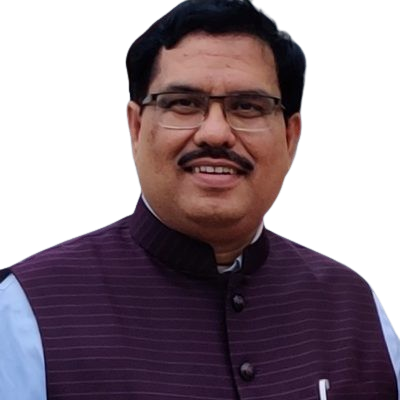
Dr. Radhakant Padhi
HAG Professor & Prof. Satish Dhawan Chair , Department of Aerospace Engineering , Indian Institute of Science (IISc), Bengaluru, IndiaProf. Radhakant Padhi is currently a higher academic grade senior Professor and the Satish Dhawan Chair in the Department of Aerospace engineering, as well as as an Associate Faculty in the Centre for Cyber-Physical Systems at the Indian Institute of Science (IISc), Bangalore. He is a Fellow of Indian National Academy of Engineering, Aeronautical Society of India, Astronautical Society of India, IETE, and Institute of Engineers India. He is an Associate Fellow of AIAA and a Senior Member of IEEE.
Prof. Padhi’s research interest is on optimal and nonlinear control synthesis algorithms and their applications to challenging practical problems in aerospace, biomedical and mechanical engineering as well as other application areas such as laser beam pointing control. He has co-authored nearly 300 peer-reviewed publications; and two books: one on "Satellite Formation Flying" and another on "Intelligent Adaptive Control with System Constraints". Another book on "Applied Optimal Control and State Estimation" will be published soon. Currently his research group is passionately involved in (i) High-Precision guidance and robust control of aerospace vehicles, (ii) High-precision pointing control of laser beams, and (iii) Robust and intelligent artificial pancreas for diabetic patients along with an IoT enabled support systems.
His recent passion is his two deep-tech startups incubated in IISc, namely VAPL.tech and VTPL.tech, one focusing on Advanced Guidance and Control of aerospace vehicles for challenging missions and the other focusing on diabetes care. Through these, he intends to focus on utilizing his knowledge and experience for the real benefit of the country and, by extension, the mankind.
Prof. Padhi is a member of technical review committees for several missions of ISRO and DRDO, including the performance analysis committee which analyzed the reasons for partial failure of Chandrayaan-2 mission and suggested the necessary improvements for the successful Chandrayaan 3 mission.
Prof. Padhi’s research interest is on optimal and nonlinear control synthesis algorithms and their applications to challenging practical problems in aerospace, biomedical and mechanical engineering as well as other application areas such as laser beam pointing control. He has co-authored nearly 300 peer-reviewed publications; and two books: one on "Satellite Formation Flying" and another on "Intelligent Adaptive Control with System Constraints". Another book on "Applied Optimal Control and State Estimation" will be published soon. Currently his research group is passionately involved in (i) High-Precision guidance and robust control of aerospace vehicles, (ii) High-precision pointing control of laser beams, and (iii) Robust and intelligent artificial pancreas for diabetic patients along with an IoT enabled support systems.
His recent passion is his two deep-tech startups incubated in IISc, namely VAPL.tech and VTPL.tech, one focusing on Advanced Guidance and Control of aerospace vehicles for challenging missions and the other focusing on diabetes care. Through these, he intends to focus on utilizing his knowledge and experience for the real benefit of the country and, by extension, the mankind.
Prof. Padhi is a member of technical review committees for several missions of ISRO and DRDO, including the performance analysis committee which analyzed the reasons for partial failure of Chandrayaan-2 mission and suggested the necessary improvements for the successful Chandrayaan 3 mission.
Abstract
Granular Computing and Deep Learning: Video Analytics and Z-numbers
The talk first describes the components of granular computing (GrC) and information granules, significance of rough sets in granular computing, and the relevance of generalized rough sets as a stronger paradigm for uncertainty modeling. The problem of unsupervised video tracking in ambiguous situations is considered as an example application of granular mining. Roles of different spatio-color and spatio-temporal granules as well as the lower and upper approximations are explained.
The second part deals with the significance of deep learning (DL) in object recognition and tracking. After explaining the relevance of granulation in CNN (convolutional neural nets) for reducing the computation time, a deep architecture, named G-RCNN (granulated region proposal neural nets) is presented. This is an improved version of the Fast RCNN and Faster RCNN for extracting RoIs (regions of interest) by incorporating spatio-temporal granulation in a deep AlexNet architecture. G-RCNN accepts videos directly as input. Spatio-temporal granules enable extraction of less but more representative RoI-pixels of object regions and thereby make the G-RCNN superior in real-time detection speed and accuracy.
As a case study, the merits of G-RCNN in terms of speed, localization and detection accuracy are demonstrated on real-time traffic scenarios in a Tata Steel Plant for anomaly detection towards safety analytics. Here the problem of “fall” and “no-fall” detection is dealt with as well as the anomaly between “collision” and “near-miss”. Significance of Z-numbers as a measure of certainty (trust) in the occurrence of collision and near-miss is illustrated. This concept is unique.
The talk concludes by mentioning the challenging issues and future directions of research including the evolution of discipline since 1960s and some concerns for beginners.
The second part deals with the significance of deep learning (DL) in object recognition and tracking. After explaining the relevance of granulation in CNN (convolutional neural nets) for reducing the computation time, a deep architecture, named G-RCNN (granulated region proposal neural nets) is presented. This is an improved version of the Fast RCNN and Faster RCNN for extracting RoIs (regions of interest) by incorporating spatio-temporal granulation in a deep AlexNet architecture. G-RCNN accepts videos directly as input. Spatio-temporal granules enable extraction of less but more representative RoI-pixels of object regions and thereby make the G-RCNN superior in real-time detection speed and accuracy.
As a case study, the merits of G-RCNN in terms of speed, localization and detection accuracy are demonstrated on real-time traffic scenarios in a Tata Steel Plant for anomaly detection towards safety analytics. Here the problem of “fall” and “no-fall” detection is dealt with as well as the anomaly between “collision” and “near-miss”. Significance of Z-numbers as a measure of certainty (trust) in the occurrence of collision and near-miss is illustrated. This concept is unique.
The talk concludes by mentioning the challenging issues and future directions of research including the evolution of discipline since 1960s and some concerns for beginners.
Biography
Padma Shri Prof. Sankar Kumar Pal
ANRF Prime Minister Professor, GoI, at IIIT Bhubaneswar, President and Emeritus Professor, Indian Statistical Institute, Kolkata; Distinguished Scientist and Former Director, ISISankar K. Pal received two PhD degrees, one from Indian Statistical Institute/University of Calcutta, Kolkata, and the other from Imperial College, London. He joined the Indian Statistical Institute (ISI), Kolkata in 1975 as a CSIR-SRF where he became a full professor in 1987, a distinguished scientist in 1998, the Director in 2005, and the President in 2022. He founded the reputable Machine Intelligence Unit and the Center for Soft Computing Research at ISI, Kolkata. Currently, he is an ANRF Prime Minister Professor, Govt. of India, an ISI Emeritus Professor, an AICTE Distinguished Chair Professor, and a Vice-President of International Artificial Intelligence Industry Alliance, Hong Kong. He is also a former SERB National Science Chair, INSA Distinguished Professor, INAE Chair Professor, and J.C. Bose National Fellow.
He worked at the University of California, Berkeley; University of Maryland, College Park; NASA Johnson Space Center, Houston, Texas; and US Naval Research Laboratory, Washington, DC. He has been an IEEE CS (USA) Distinguished visitor since 1987 and held several visiting positions in Italy, Poland, France, Hong Kong and Australia.
He has made fundamental contributions to machine intelligence research by developing various modern approaches. He pioneered the development of fuzzy set theory, and neuro-fuzzy and rough-fuzzy computing for uncertainty modelling when the pattern indeterminacy is due to vagueness rather than randomness, and their applications in pattern recognition, image processing, machine learning, case-based reasoning, knowledge-based systems, granular data mining, and cognitive machines, in particular. His image processing research in 1970s is perhaps the first investigation (other investigator: A. Rosenfeld, UMD, College Park, USA) that brings out the root relation between the abstract concept of fuzzy sets and image processing tasks and the associated uncertainties/ambiguities. Family of generic fuzzy neural networks, pioneered in early 1990s from his group, which can accept linguistic input, constitute the basic modules that laid the foundation of soft computing. It also provides a basic framework for today’s Explainable AI.
He has coauthored 21 books, 500+ research publications and 2 US patents. He was instrumental in introducing the soft computing concept and research in India back in mid-1990s. The DST, Govt. of India, established under his leadership Asia’s first Center for Soft Computing Research in 2004 at ISI, Kolkata. Subsequently, this Center became an Associate Institute of ISI in 2010.
Prof. Pal received numerous national/ international awards including the S.S. Bhatnagar Prize, the Padma Shri, the G.D Birla Award, and the Khwarizmi International Award (Iran). He is/was on the editorial boards of 25 international journals including several IEEE Transactions. He is a Fellow of TWAS, IAPR, IFSA, IRSS, AAIA, AIIA and all the four National Academies for Science/Engineering in India. He is also a foreign member of the European Academy of Sciences and Arts.
He worked at the University of California, Berkeley; University of Maryland, College Park; NASA Johnson Space Center, Houston, Texas; and US Naval Research Laboratory, Washington, DC. He has been an IEEE CS (USA) Distinguished visitor since 1987 and held several visiting positions in Italy, Poland, France, Hong Kong and Australia.
He has made fundamental contributions to machine intelligence research by developing various modern approaches. He pioneered the development of fuzzy set theory, and neuro-fuzzy and rough-fuzzy computing for uncertainty modelling when the pattern indeterminacy is due to vagueness rather than randomness, and their applications in pattern recognition, image processing, machine learning, case-based reasoning, knowledge-based systems, granular data mining, and cognitive machines, in particular. His image processing research in 1970s is perhaps the first investigation (other investigator: A. Rosenfeld, UMD, College Park, USA) that brings out the root relation between the abstract concept of fuzzy sets and image processing tasks and the associated uncertainties/ambiguities. Family of generic fuzzy neural networks, pioneered in early 1990s from his group, which can accept linguistic input, constitute the basic modules that laid the foundation of soft computing. It also provides a basic framework for today’s Explainable AI.
He has coauthored 21 books, 500+ research publications and 2 US patents. He was instrumental in introducing the soft computing concept and research in India back in mid-1990s. The DST, Govt. of India, established under his leadership Asia’s first Center for Soft Computing Research in 2004 at ISI, Kolkata. Subsequently, this Center became an Associate Institute of ISI in 2010.
Prof. Pal received numerous national/ international awards including the S.S. Bhatnagar Prize, the Padma Shri, the G.D Birla Award, and the Khwarizmi International Award (Iran). He is/was on the editorial boards of 25 international journals including several IEEE Transactions. He is a Fellow of TWAS, IAPR, IFSA, IRSS, AAIA, AIIA and all the four National Academies for Science/Engineering in India. He is also a foreign member of the European Academy of Sciences and Arts.
Abstract
Engineering the Future: From Technology to Transformation
Engineering is no longer only about designing systems, building products or solving technical problem, it is about shaping the future. As artificial intelligence, digital transformation, sustainability and emerging technologies redefine industries, women engineers have an unprecedented opportunity to move from being participants in technological change to becoming its architects and leaders.
This keynote will explore how women can leverage their technical capabilities, creativity, empathy and collaborative leadership to create meaningful impact across business and society. It will examine the changing role of engineers in an AI-driven world, the importance of continuous learning, innovation and entrepreneurship, and the need to build confidence and leadership beyond conventional professional boundaries.
Drawing from experiences in technology entrepreneurship, digital transformation and leadership, the session will encourage women engineers to think beyond job descriptions, embrace ambiguity, build networks, take calculated risks and lead with purpose. This will also delve upon their role in contributing to Vikshit Bharat.
Message from the Keynote: the future does not merely need more women in engineering; it needs more women engineering the future.
This keynote will explore how women can leverage their technical capabilities, creativity, empathy and collaborative leadership to create meaningful impact across business and society. It will examine the changing role of engineers in an AI-driven world, the importance of continuous learning, innovation and entrepreneurship, and the need to build confidence and leadership beyond conventional professional boundaries.
Drawing from experiences in technology entrepreneurship, digital transformation and leadership, the session will encourage women engineers to think beyond job descriptions, embrace ambiguity, build networks, take calculated risks and lead with purpose. This will also delve upon their role in contributing to Vikshit Bharat.
Message from the Keynote: the future does not merely need more women in engineering; it needs more women engineering the future.
Biography
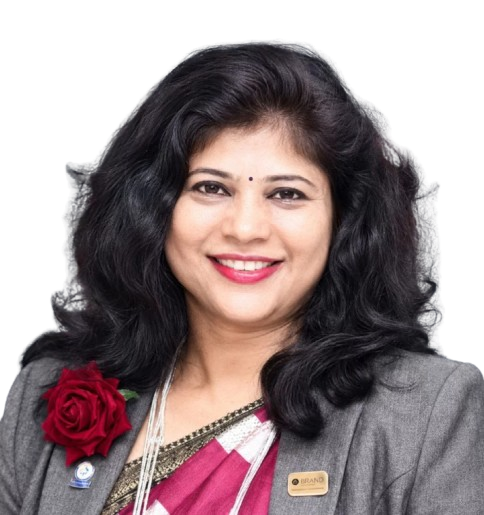
PDG Jayashree Mohanty
Co-Founder & President, Luminous Infoways, First Female Rotary District Governor of Odisha (2023–24); Founding Chair, CII IWN; Member, NASSCOM Regional CouncilPDG Jayashree Mohanty is a technology entrepreneur, business leader and passionate advocate for women's leadership and inclusive growth. She is the Co-founder & President of Luminous Infoways Pvt. Ltd., a technology company with over two decades of experience in IT services, digital transformation, software solutions, artificial intelligence, analytics and large-scale digitisation initiatives. It is recognized as the Brand of Odisha Pride of India employing over a thousand people and has developed clientele in India, USA, UK, Middle East, Africa, Norway, New Zealand and Australia.
A strong believer in the power of technology to transform governance, business and society, Jayashree has been associated with several industry and professional platforms, including CII and NASSCOM, and has played an active role in promoting women's participation in business and leadership. She is the Founding Chair of the CII–Indian Women Network, Odisha, Member of NASSCOM Regional Council and Member - CII Industry Academic Collaboration National Council. A distinguished Rotary leader, she has served as the first woman District Governor of Rotary International District 3262, bringing her focus on leadership, service, diversity, equity and inclusion to a wide community. Awarded with many accolades for her accomplishments. National Awards on e-Governance, Web Ratna, STPI exports award for leading woman entrepreneur, Woman IT leader promoting women in MSME, the best IT service provider by CII and Govt of India.
Jayashree combines her entrepreneurial journey with a strong commitment to mentoring, empowering women and creating opportunities for young professionals. As Member, Startup Taskforce Govt of Odisha, she has mentored thousands of startups and emerging entrepreneurs. Her leadership philosophy is rooted in innovation, collaboration, resilience and purpose, with a firm belief that technology becomes truly transformative when it improves lives and creates inclusive opportunities. Her philosophy in life "As individuals we are a drop, together we are an ocean".
A strong believer in the power of technology to transform governance, business and society, Jayashree has been associated with several industry and professional platforms, including CII and NASSCOM, and has played an active role in promoting women's participation in business and leadership. She is the Founding Chair of the CII–Indian Women Network, Odisha, Member of NASSCOM Regional Council and Member - CII Industry Academic Collaboration National Council. A distinguished Rotary leader, she has served as the first woman District Governor of Rotary International District 3262, bringing her focus on leadership, service, diversity, equity and inclusion to a wide community. Awarded with many accolades for her accomplishments. National Awards on e-Governance, Web Ratna, STPI exports award for leading woman entrepreneur, Woman IT leader promoting women in MSME, the best IT service provider by CII and Govt of India.
Jayashree combines her entrepreneurial journey with a strong commitment to mentoring, empowering women and creating opportunities for young professionals. As Member, Startup Taskforce Govt of Odisha, she has mentored thousands of startups and emerging entrepreneurs. Her leadership philosophy is rooted in innovation, collaboration, resilience and purpose, with a firm belief that technology becomes truly transformative when it improves lives and creates inclusive opportunities. Her philosophy in life "As individuals we are a drop, together we are an ocean".
Abstract
AI-Driven Open Science Cyberinfrastructure: Rethinking How Scientific Knowledge Is Created, Shared, and Reused
Scientific discovery increasingly depends on software, data, computational models, workflows, and collaboration across disciplinary boundaries. Yet the scientific enterprise is still organized largely around static publications, fragmented repositories, and incentive structures that do not adequately reward openness, reproducibility, reuse, or long-term stewardship of research artifacts.
This keynote will examine how artificial intelligence and cyberinfrastructure can be combined to create a more open, connected, and effective scientific ecosystem. In such an ecosystem, research outputs would be represented not only as papers, but also as machine-actionable collections of claims, evidence, data, software, models, parameters, workflows, validation results, and provenance. AI could help researchers discover relevant knowledge, identify suitable methods and models, generate and validate computational implementations, detect inconsistencies, reproduce results, synthesize evidence, and find opportunities for collaboration.
The talk will also address the social and institutional dimensions of this transformation. Technical infrastructure alone will not be sufficient. Sustainable adoption will require community governance, trustworthy human–AI interaction, interoperable standards, transparent validation, and new incentive mechanisms that recognize contributions such as software, data, curation, replication, and reuse. Drawing on developments in open science, research software, scientific AI, and community cyberinfrastructure, the keynote will outline both emerging opportunities and unresolved challenges.
The central argument is that AI should not simply accelerate the current publication-centered system. It should help redesign the scientific process around open, computable, reusable knowledge, while preserving human responsibility for scientific judgment. Such AI-driven open science cyberinfrastructure could support faster discovery, stronger reproducibility, broader participation, and more sustainable scientific innovation.
This keynote will examine how artificial intelligence and cyberinfrastructure can be combined to create a more open, connected, and effective scientific ecosystem. In such an ecosystem, research outputs would be represented not only as papers, but also as machine-actionable collections of claims, evidence, data, software, models, parameters, workflows, validation results, and provenance. AI could help researchers discover relevant knowledge, identify suitable methods and models, generate and validate computational implementations, detect inconsistencies, reproduce results, synthesize evidence, and find opportunities for collaboration.
The talk will also address the social and institutional dimensions of this transformation. Technical infrastructure alone will not be sufficient. Sustainable adoption will require community governance, trustworthy human–AI interaction, interoperable standards, transparent validation, and new incentive mechanisms that recognize contributions such as software, data, curation, replication, and reuse. Drawing on developments in open science, research software, scientific AI, and community cyberinfrastructure, the keynote will outline both emerging opportunities and unresolved challenges.
The central argument is that AI should not simply accelerate the current publication-centered system. It should help redesign the scientific process around open, computable, reusable knowledge, while preserving human responsibility for scientific judgment. Such AI-driven open science cyberinfrastructure could support faster discovery, stronger reproducibility, broader participation, and more sustainable scientific innovation.
Biography
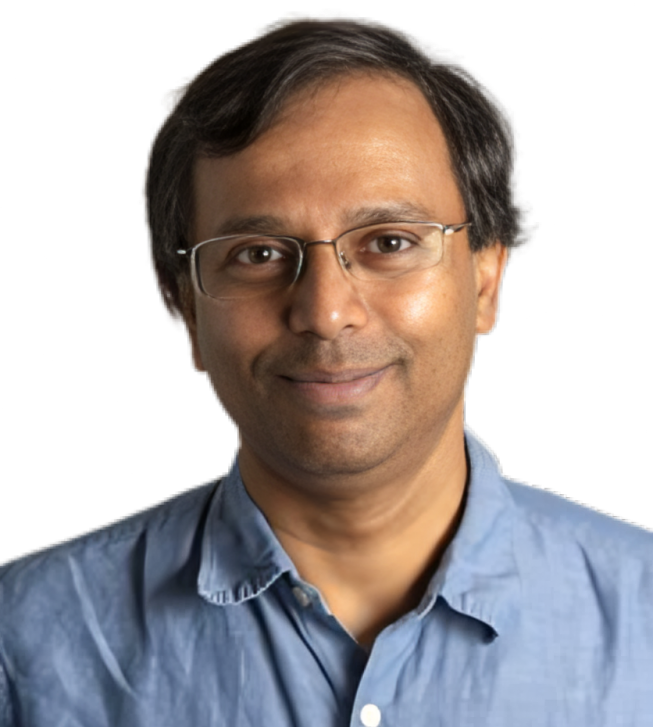
Dr. Ashok Srinivasan
William Nystul Eminent Scholar Chair and Professor, Dept. of Computer Science , University of West Florida, USAAshok Srinivasan is the William Nystul Eminent Scholar Chair and Professor of Computer Science at the University of West Florida. His research and leadership span high-performance computing, cyberinfrastructure, AI-enabled scientific discovery, and open science, with applications in public health, computational science, and interdisciplinary modeling. From 2022 to 2024, he served as a Program Director in the Office of Advanced Cyberinfrastructure at the U.S. National Science Foundation, where he managed a large research portfolio and helped shape national initiatives in cybertraining, public access, and open science. He has led and collaborated on numerous multi-institutional projects funded by agencies including NSF and NIH, and his research has been featured in over 300 news outlets and cited in testimony to the U.S. Congress.
Abstract
India’s Journey to the Moon and Its Impact on Future Space Exploration
Lunar exploration missions of India have enhanced scientific understanding of the Moon’s surface composition, thermal characteristics, seismic activity, plasma environment, and near-surface conditions. They have also contributed to the development of critical capabilities in spacecraft navigation, propulsion, deep-space communication, autonomous landing, rover operations, and in situ scientific experimentation.
The knowledge, experience, and technological capabilities gained through the Chandrayaan programme are expected to influence India’s future missions to the Moon and beyond. Theyprovide a foundation for advanced lunar research, sample-return missions, international scientific collaboration, exploration of lunar resources, and future human lunar exploration. India’s journey to the Moon is therefore not only a significant national achievement but also an important contribution to humanity’s continuing exploration of space and an inspiration for future generations of scientists and engineers.
The knowledge, experience, and technological capabilities gained through the Chandrayaan programme are expected to influence India’s future missions to the Moon and beyond. Theyprovide a foundation for advanced lunar research, sample-return missions, international scientific collaboration, exploration of lunar resources, and future human lunar exploration. India’s journey to the Moon is therefore not only a significant national achievement but also an important contribution to humanity’s continuing exploration of space and an inspiration for future generations of scientists and engineers.
Biography
Padma Shri A. S. Kiran Kumar
Former Chairman, ISRO, Former Secretary, Department of Space, Govt. of India; Former Director, Space Applications Centre (SAC), ISRO ; Vikram Sarabhai Professor, ISRO; Chairman, Physical Research Laboratory Management Council and Member, Space Commission, Government of IndiaShri A. S. Kiran Kumar is Chairman, Physical Research Laboratory Management Council and Member, Space Commission, Govt of India.
He has served as Secretary, Department of Space and Chairman, Indian Space Research Organisation, during 2015-2018.
Shri Kiran Kumar, born on October 22, 1952 in Hassan, Karnataka, holds M.Sc. Degree in Physics (Electronics) from Bangalore University and M.Tech. Degree in Physical Engineering from Indian Institute of Science, Bangalore.
He has steered the implementation of the applications oriented Indian Space Programme, which has facilitated rapid development of the country in many important spheres of earth observation, communication, navigation, meteorology and space science, as well as the development of indigenous launch vehicles and related technologies for providing assured access to space. He has led design and development of more than 50 Electro-Optical Imaging Sensors flown on various Space borne platforms starting from Bhaskara in 1979. Further, his role in the success of Chandrayaan missions and Mars Orbiter Mission has been significant.
Shri Kiran Kumar has been the Chair of the Committee on Earth Observation Satellites (CEOS) in 2012. He has made valuable contributions to Coordination Group of Meteorological Satellites (CGMS), Expert Team on Satellite Systems – World Meteorological Organisation (ETSAT of WMO) and Indo-US Joint Working Group on Civil Space Cooperation.
Shri Kiran Kumar has been the President, Aeronautical Society of India. He is Fellow of Indian National Academy of Engineering, National Academy of Sciences India, Indian Society of Remote Sensing, Institution of Electronics & Telecommunications Engineers, Indian Society of Systems for Science & Engineering, Indian Meteorological Society, Indian Society of Geomatics, Gujarat Science Academy, Andhra Pradesh Akademi of Sciences and an elected member of International Academy of Astronautics. He has been conferred with Honoris Causa and DSc by 18 Indian academic institutions.
He has co-authored 85 publications in various national/international scientific journals/conferences/symposiums.
In recognition of his contributions, he was conferred Padma Shri by the President of India in 2014. Other notable honours conferred on him include, Rajyostava Award by for 2015, `Sir M. Visvesvaraya Senior Scientist State Award’ for 2013 by Government of Karnataka, Lifetime Achievement Award from Karnataka Science and Technology Academy in 2016, IISc Distinguished Alumnus Award for 2015, Gujarat Ratna `Life for Innovation’ Award conferred by Gujarat Innovation Society in 2014, Lifetime Achievement Award by Andhra Pradesh Akademi of Sciences in 2016, Bharat Ratna Sir M. Visvesvaraya Centenary Award by University of Mysore in 2016, G.M. Modi Science Award in 2016, H K Firodia Vijnan Ratna Award in 2017, Santokbaa Award instituted by SRKKF Surat in 2018 and ISRO Lifetime Achievement Award 2018. He has been conferred with the prestigious 2018 International von Karman Wings Award instituted by the Aerospace Historical Society,together with the Graduate Aerospace Laboratories at the California Institute of Technology, in 2018 and the Chevalier de l'Ordre national de la Légion d'Honneur – the highest civilian honour by the Government of France in 2019.
He has served as Secretary, Department of Space and Chairman, Indian Space Research Organisation, during 2015-2018.
Shri Kiran Kumar, born on October 22, 1952 in Hassan, Karnataka, holds M.Sc. Degree in Physics (Electronics) from Bangalore University and M.Tech. Degree in Physical Engineering from Indian Institute of Science, Bangalore.
He has steered the implementation of the applications oriented Indian Space Programme, which has facilitated rapid development of the country in many important spheres of earth observation, communication, navigation, meteorology and space science, as well as the development of indigenous launch vehicles and related technologies for providing assured access to space. He has led design and development of more than 50 Electro-Optical Imaging Sensors flown on various Space borne platforms starting from Bhaskara in 1979. Further, his role in the success of Chandrayaan missions and Mars Orbiter Mission has been significant.
Shri Kiran Kumar has been the Chair of the Committee on Earth Observation Satellites (CEOS) in 2012. He has made valuable contributions to Coordination Group of Meteorological Satellites (CGMS), Expert Team on Satellite Systems – World Meteorological Organisation (ETSAT of WMO) and Indo-US Joint Working Group on Civil Space Cooperation.
Shri Kiran Kumar has been the President, Aeronautical Society of India. He is Fellow of Indian National Academy of Engineering, National Academy of Sciences India, Indian Society of Remote Sensing, Institution of Electronics & Telecommunications Engineers, Indian Society of Systems for Science & Engineering, Indian Meteorological Society, Indian Society of Geomatics, Gujarat Science Academy, Andhra Pradesh Akademi of Sciences and an elected member of International Academy of Astronautics. He has been conferred with Honoris Causa and DSc by 18 Indian academic institutions.
He has co-authored 85 publications in various national/international scientific journals/conferences/symposiums.
In recognition of his contributions, he was conferred Padma Shri by the President of India in 2014. Other notable honours conferred on him include, Rajyostava Award by for 2015, `Sir M. Visvesvaraya Senior Scientist State Award’ for 2013 by Government of Karnataka, Lifetime Achievement Award from Karnataka Science and Technology Academy in 2016, IISc Distinguished Alumnus Award for 2015, Gujarat Ratna `Life for Innovation’ Award conferred by Gujarat Innovation Society in 2014, Lifetime Achievement Award by Andhra Pradesh Akademi of Sciences in 2016, Bharat Ratna Sir M. Visvesvaraya Centenary Award by University of Mysore in 2016, G.M. Modi Science Award in 2016, H K Firodia Vijnan Ratna Award in 2017, Santokbaa Award instituted by SRKKF Surat in 2018 and ISRO Lifetime Achievement Award 2018. He has been conferred with the prestigious 2018 International von Karman Wings Award instituted by the Aerospace Historical Society,together with the Graduate Aerospace Laboratories at the California Institute of Technology, in 2018 and the Chevalier de l'Ordre national de la Légion d'Honneur – the highest civilian honour by the Government of France in 2019.
Abstract
Optimal Guidance for Soft-Landing in Space Missions
High-precision autonomous soft-landing is increasingly becoming an essential requirement for various interplanetary missions, and also for stage recovery of launch vehicles for reusability. From the guidance control perspective, the problem can be broadly classified into two categories: (i) landing on atmosphere-less planets and satellites (such as Moon) and (ii) landing on planets and satellites with atmosphere (such as Earth and Mars). Optimal guidance plays a very important role in both, as it can generate optimal trajectories satisfying system dynamics, boundary conditions, applicable constraints and yet ensuring a meaningful optimality (such as acceleration/jerk/fuel optimality). This talk will give an overview of both aspects of this critical technology.
First part of this talk will remain focused on the Chandrayaan mission of India. It will include some of the lessons learnt from the unsuccessful attempt of Chandrayaan-2, followed by the improvements carried out subsequently that led to the success of the Chandrayaan-3 mission. Focus will be on the guidance system improvement, including the contributions made by the speaker and his research group. Next, the launch vehicle stage recovery problem will be discussed, including the challenges it offers. To tackle this problem, a strong pitch will be made in favour of the nonlinear optimal control theory based next-generation computational guidance, and why India is ready for this challenge.
First part of this talk will remain focused on the Chandrayaan mission of India. It will include some of the lessons learnt from the unsuccessful attempt of Chandrayaan-2, followed by the improvements carried out subsequently that led to the success of the Chandrayaan-3 mission. Focus will be on the guidance system improvement, including the contributions made by the speaker and his research group. Next, the launch vehicle stage recovery problem will be discussed, including the challenges it offers. To tackle this problem, a strong pitch will be made in favour of the nonlinear optimal control theory based next-generation computational guidance, and why India is ready for this challenge.
Biography
Dr. Radhakant Padhi
HAG Professor & Prof. Satish Dhawan Chair , Department of Aerospace Engineering , Indian Institute of Science (IISc), Bengaluru, IndiaProf. Radhakant Padhi is currently a higher academic grade senior Professor and the Satish Dhawan Chair in the Department of Aerospace engineering, as well as as an Associate Faculty in the Centre for Cyber-Physical Systems at the Indian Institute of Science (IISc), Bangalore. He is a Fellow of Indian National Academy of Engineering, Aeronautical Society of India, Astronautical Society of India, IETE, and Institute of Engineers India. He is an Associate Fellow of AIAA and a Senior Member of IEEE.
Prof. Padhi’s research interest is on optimal and nonlinear control synthesis algorithms and their applications to challenging practical problems in aerospace, biomedical and mechanical engineering as well as other application areas such as laser beam pointing control. He has co-authored nearly 300 peer-reviewed publications; and two books: one on "Satellite Formation Flying" and another on "Intelligent Adaptive Control with System Constraints". Another book on "Applied Optimal Control and State Estimation" will be published soon. Currently his research group is passionately involved in (i) High-Precision guidance and robust control of aerospace vehicles, (ii) High-precision pointing control of laser beams, and (iii) Robust and intelligent artificial pancreas for diabetic patients along with an IoT enabled support systems.
His recent passion is his two deep-tech startups incubated in IISc, namely VAPL.tech and VTPL.tech, one focusing on Advanced Guidance and Control of aerospace vehicles for challenging missions and the other focusing on diabetes care. Through these, he intends to focus on utilizing his knowledge and experience for the real benefit of the country and, by extension, the mankind.
Prof. Padhi is a member of technical review committees for several missions of ISRO and DRDO, including the performance analysis committee which analyzed the reasons for partial failure of Chandrayaan-2 mission and suggested the necessary improvements for the successful Chandrayaan 3 mission.
Prof. Padhi’s research interest is on optimal and nonlinear control synthesis algorithms and their applications to challenging practical problems in aerospace, biomedical and mechanical engineering as well as other application areas such as laser beam pointing control. He has co-authored nearly 300 peer-reviewed publications; and two books: one on "Satellite Formation Flying" and another on "Intelligent Adaptive Control with System Constraints". Another book on "Applied Optimal Control and State Estimation" will be published soon. Currently his research group is passionately involved in (i) High-Precision guidance and robust control of aerospace vehicles, (ii) High-precision pointing control of laser beams, and (iii) Robust and intelligent artificial pancreas for diabetic patients along with an IoT enabled support systems.
His recent passion is his two deep-tech startups incubated in IISc, namely VAPL.tech and VTPL.tech, one focusing on Advanced Guidance and Control of aerospace vehicles for challenging missions and the other focusing on diabetes care. Through these, he intends to focus on utilizing his knowledge and experience for the real benefit of the country and, by extension, the mankind.
Prof. Padhi is a member of technical review committees for several missions of ISRO and DRDO, including the performance analysis committee which analyzed the reasons for partial failure of Chandrayaan-2 mission and suggested the necessary improvements for the successful Chandrayaan 3 mission.
Abstract
Granular Computing and Deep Learning: Video Analytics and Z-numbers
The talk first describes the components of granular computing (GrC) and information granules, significance of rough sets in granular computing, and the relevance of generalized rough sets as a stronger paradigm for uncertainty modeling. The problem of unsupervised video tracking in ambiguous situations is considered as an example application of granular mining. Roles of different spatio-color and spatio-temporal granules as well as the lower and upper approximations are explained.
The second part deals with the significance of deep learning (DL) in object recognition and tracking. After explaining the relevance of granulation in CNN (convolutional neural nets) for reducing the computation time, a deep architecture, named G-RCNN (granulated region proposal neural nets) is presented. This is an improved version of the Fast RCNN and Faster RCNN for extracting RoIs (regions of interest) by incorporating spatio-temporal granulation in a deep AlexNet architecture. G-RCNN accepts videos directly as input. Spatio-temporal granules enable extraction of less but more representative RoI-pixels of object regions and thereby make the G-RCNN superior in real-time detection speed and accuracy.
As a case study, the merits of G-RCNN in terms of speed, localization and detection accuracy are demonstrated on real-time traffic scenarios in a Tata Steel Plant for anomaly detection towards safety analytics. Here the problem of “fall” and “no-fall” detection is dealt with as well as the anomaly between “collision” and “near-miss”. Significance of Z-numbers as a measure of certainty (trust) in the occurrence of collision and near-miss is illustrated. This concept is unique.
The talk concludes by mentioning the challenging issues and future directions of research including the evolution of discipline since 1960s and some concerns for beginners.
The second part deals with the significance of deep learning (DL) in object recognition and tracking. After explaining the relevance of granulation in CNN (convolutional neural nets) for reducing the computation time, a deep architecture, named G-RCNN (granulated region proposal neural nets) is presented. This is an improved version of the Fast RCNN and Faster RCNN for extracting RoIs (regions of interest) by incorporating spatio-temporal granulation in a deep AlexNet architecture. G-RCNN accepts videos directly as input. Spatio-temporal granules enable extraction of less but more representative RoI-pixels of object regions and thereby make the G-RCNN superior in real-time detection speed and accuracy.
As a case study, the merits of G-RCNN in terms of speed, localization and detection accuracy are demonstrated on real-time traffic scenarios in a Tata Steel Plant for anomaly detection towards safety analytics. Here the problem of “fall” and “no-fall” detection is dealt with as well as the anomaly between “collision” and “near-miss”. Significance of Z-numbers as a measure of certainty (trust) in the occurrence of collision and near-miss is illustrated. This concept is unique.
The talk concludes by mentioning the challenging issues and future directions of research including the evolution of discipline since 1960s and some concerns for beginners.
Biography
Padma Shri Prof. Sankar Kumar Pal
ANRF Prime Minister Professor, GoI, at IIIT Bhubaneswar, President and Emeritus Professor, Indian Statistical Institute, Kolkata; Distinguished Scientist and Former Director, ISISankar K. Pal received two PhD degrees, one from Indian Statistical Institute/University of Calcutta, Kolkata, and the other from Imperial College, London. He joined the Indian Statistical Institute (ISI), Kolkata in 1975 as a CSIR-SRF where he became a full professor in 1987, a distinguished scientist in 1998, the Director in 2005, and the President in 2022. He founded the reputable Machine Intelligence Unit and the Center for Soft Computing Research at ISI, Kolkata. Currently, he is an ANRF Prime Minister Professor, Govt. of India, an ISI Emeritus Professor, an AICTE Distinguished Chair Professor, and a Vice-President of International Artificial Intelligence Industry Alliance, Hong Kong. He is also a former SERB National Science Chair, INSA Distinguished Professor, INAE Chair Professor, and J.C. Bose National Fellow.
He worked at the University of California, Berkeley; University of Maryland, College Park; NASA Johnson Space Center, Houston, Texas; and US Naval Research Laboratory, Washington, DC. He has been an IEEE CS (USA) Distinguished visitor since 1987 and held several visiting positions in Italy, Poland, France, Hong Kong and Australia.
He has made fundamental contributions to machine intelligence research by developing various modern approaches. He pioneered the development of fuzzy set theory, and neuro-fuzzy and rough-fuzzy computing for uncertainty modelling when the pattern indeterminacy is due to vagueness rather than randomness, and their applications in pattern recognition, image processing, machine learning, case-based reasoning, knowledge-based systems, granular data mining, and cognitive machines, in particular. His image processing research in 1970s is perhaps the first investigation (other investigator: A. Rosenfeld, UMD, College Park, USA) that brings out the root relation between the abstract concept of fuzzy sets and image processing tasks and the associated uncertainties/ambiguities. Family of generic fuzzy neural networks, pioneered in early 1990s from his group, which can accept linguistic input, constitute the basic modules that laid the foundation of soft computing. It also provides a basic framework for today’s Explainable AI.
He has coauthored 21 books, 500+ research publications and 2 US patents. He was instrumental in introducing the soft computing concept and research in India back in mid-1990s. The DST, Govt. of India, established under his leadership Asia’s first Center for Soft Computing Research in 2004 at ISI, Kolkata. Subsequently, this Center became an Associate Institute of ISI in 2010.
Prof. Pal received numerous national/ international awards including the S.S. Bhatnagar Prize, the Padma Shri, the G.D Birla Award, and the Khwarizmi International Award (Iran). He is/was on the editorial boards of 25 international journals including several IEEE Transactions. He is a Fellow of TWAS, IAPR, IFSA, IRSS, AAIA, AIIA and all the four National Academies for Science/Engineering in India. He is also a foreign member of the European Academy of Sciences and Arts.
He worked at the University of California, Berkeley; University of Maryland, College Park; NASA Johnson Space Center, Houston, Texas; and US Naval Research Laboratory, Washington, DC. He has been an IEEE CS (USA) Distinguished visitor since 1987 and held several visiting positions in Italy, Poland, France, Hong Kong and Australia.
He has made fundamental contributions to machine intelligence research by developing various modern approaches. He pioneered the development of fuzzy set theory, and neuro-fuzzy and rough-fuzzy computing for uncertainty modelling when the pattern indeterminacy is due to vagueness rather than randomness, and their applications in pattern recognition, image processing, machine learning, case-based reasoning, knowledge-based systems, granular data mining, and cognitive machines, in particular. His image processing research in 1970s is perhaps the first investigation (other investigator: A. Rosenfeld, UMD, College Park, USA) that brings out the root relation between the abstract concept of fuzzy sets and image processing tasks and the associated uncertainties/ambiguities. Family of generic fuzzy neural networks, pioneered in early 1990s from his group, which can accept linguistic input, constitute the basic modules that laid the foundation of soft computing. It also provides a basic framework for today’s Explainable AI.
He has coauthored 21 books, 500+ research publications and 2 US patents. He was instrumental in introducing the soft computing concept and research in India back in mid-1990s. The DST, Govt. of India, established under his leadership Asia’s first Center for Soft Computing Research in 2004 at ISI, Kolkata. Subsequently, this Center became an Associate Institute of ISI in 2010.
Prof. Pal received numerous national/ international awards including the S.S. Bhatnagar Prize, the Padma Shri, the G.D Birla Award, and the Khwarizmi International Award (Iran). He is/was on the editorial boards of 25 international journals including several IEEE Transactions. He is a Fellow of TWAS, IAPR, IFSA, IRSS, AAIA, AIIA and all the four National Academies for Science/Engineering in India. He is also a foreign member of the European Academy of Sciences and Arts.
Abstract
Engineering the Future: From Technology to Transformation
Engineering is no longer only about designing systems, building products or solving technical problem, it is about shaping the future. As artificial intelligence, digital transformation, sustainability and emerging technologies redefine industries, women engineers have an unprecedented opportunity to move from being participants in technological change to becoming its architects and leaders.
This keynote will explore how women can leverage their technical capabilities, creativity, empathy and collaborative leadership to create meaningful impact across business and society. It will examine the changing role of engineers in an AI-driven world, the importance of continuous learning, innovation and entrepreneurship, and the need to build confidence and leadership beyond conventional professional boundaries.
Drawing from experiences in technology entrepreneurship, digital transformation and leadership, the session will encourage women engineers to think beyond job descriptions, embrace ambiguity, build networks, take calculated risks and lead with purpose. This will also delve upon their role in contributing to Vikshit Bharat.
Message from the Keynote: the future does not merely need more women in engineering; it needs more women engineering the future.
This keynote will explore how women can leverage their technical capabilities, creativity, empathy and collaborative leadership to create meaningful impact across business and society. It will examine the changing role of engineers in an AI-driven world, the importance of continuous learning, innovation and entrepreneurship, and the need to build confidence and leadership beyond conventional professional boundaries.
Drawing from experiences in technology entrepreneurship, digital transformation and leadership, the session will encourage women engineers to think beyond job descriptions, embrace ambiguity, build networks, take calculated risks and lead with purpose. This will also delve upon their role in contributing to Vikshit Bharat.
Message from the Keynote: the future does not merely need more women in engineering; it needs more women engineering the future.
Biography
PDG Jayashree Mohanty
Co-Founder & President, Luminous Infoways, First Female Rotary District Governor of Odisha (2023–24); Founding Chair, CII IWN; Member, NASSCOM Regional CouncilPDG Jayashree Mohanty is a technology entrepreneur, business leader and passionate advocate for women's leadership and inclusive growth. She is the Co-founder & President of Luminous Infoways Pvt. Ltd., a technology company with over two decades of experience in IT services, digital transformation, software solutions, artificial intelligence, analytics and large-scale digitisation initiatives. It is recognized as the Brand of Odisha Pride of India employing over a thousand people and has developed clientele in India, USA, UK, Middle East, Africa, Norway, New Zealand and Australia.
A strong believer in the power of technology to transform governance, business and society, Jayashree has been associated with several industry and professional platforms, including CII and NASSCOM, and has played an active role in promoting women's participation in business and leadership. She is the Founding Chair of the CII–Indian Women Network, Odisha, Member of NASSCOM Regional Council and Member - CII Industry Academic Collaboration National Council. A distinguished Rotary leader, she has served as the first woman District Governor of Rotary International District 3262, bringing her focus on leadership, service, diversity, equity and inclusion to a wide community. Awarded with many accolades for her accomplishments. National Awards on e-Governance, Web Ratna, STPI exports award for leading woman entrepreneur, Woman IT leader promoting women in MSME, the best IT service provider by CII and Govt of India.
Jayashree combines her entrepreneurial journey with a strong commitment to mentoring, empowering women and creating opportunities for young professionals. As Member, Startup Taskforce Govt of Odisha, she has mentored thousands of startups and emerging entrepreneurs. Her leadership philosophy is rooted in innovation, collaboration, resilience and purpose, with a firm belief that technology becomes truly transformative when it improves lives and creates inclusive opportunities. Her philosophy in life "As individuals we are a drop, together we are an ocean".
A strong believer in the power of technology to transform governance, business and society, Jayashree has been associated with several industry and professional platforms, including CII and NASSCOM, and has played an active role in promoting women's participation in business and leadership. She is the Founding Chair of the CII–Indian Women Network, Odisha, Member of NASSCOM Regional Council and Member - CII Industry Academic Collaboration National Council. A distinguished Rotary leader, she has served as the first woman District Governor of Rotary International District 3262, bringing her focus on leadership, service, diversity, equity and inclusion to a wide community. Awarded with many accolades for her accomplishments. National Awards on e-Governance, Web Ratna, STPI exports award for leading woman entrepreneur, Woman IT leader promoting women in MSME, the best IT service provider by CII and Govt of India.
Jayashree combines her entrepreneurial journey with a strong commitment to mentoring, empowering women and creating opportunities for young professionals. As Member, Startup Taskforce Govt of Odisha, she has mentored thousands of startups and emerging entrepreneurs. Her leadership philosophy is rooted in innovation, collaboration, resilience and purpose, with a firm belief that technology becomes truly transformative when it improves lives and creates inclusive opportunities. Her philosophy in life "As individuals we are a drop, together we are an ocean".
Abstract
AI-Driven Open Science Cyberinfrastructure: Rethinking How Scientific Knowledge Is Created, Shared, and Reused
Scientific discovery increasingly depends on software, data, computational models, workflows, and collaboration across disciplinary boundaries. Yet the scientific enterprise is still organized largely around static publications, fragmented repositories, and incentive structures that do not adequately reward openness, reproducibility, reuse, or long-term stewardship of research artifacts.
This keynote will examine how artificial intelligence and cyberinfrastructure can be combined to create a more open, connected, and effective scientific ecosystem. In such an ecosystem, research outputs would be represented not only as papers, but also as machine-actionable collections of claims, evidence, data, software, models, parameters, workflows, validation results, and provenance. AI could help researchers discover relevant knowledge, identify suitable methods and models, generate and validate computational implementations, detect inconsistencies, reproduce results, synthesize evidence, and find opportunities for collaboration.
The talk will also address the social and institutional dimensions of this transformation. Technical infrastructure alone will not be sufficient. Sustainable adoption will require community governance, trustworthy human–AI interaction, interoperable standards, transparent validation, and new incentive mechanisms that recognize contributions such as software, data, curation, replication, and reuse. Drawing on developments in open science, research software, scientific AI, and community cyberinfrastructure, the keynote will outline both emerging opportunities and unresolved challenges.
The central argument is that AI should not simply accelerate the current publication-centered system. It should help redesign the scientific process around open, computable, reusable knowledge, while preserving human responsibility for scientific judgment. Such AI-driven open science cyberinfrastructure could support faster discovery, stronger reproducibility, broader participation, and more sustainable scientific innovation.
This keynote will examine how artificial intelligence and cyberinfrastructure can be combined to create a more open, connected, and effective scientific ecosystem. In such an ecosystem, research outputs would be represented not only as papers, but also as machine-actionable collections of claims, evidence, data, software, models, parameters, workflows, validation results, and provenance. AI could help researchers discover relevant knowledge, identify suitable methods and models, generate and validate computational implementations, detect inconsistencies, reproduce results, synthesize evidence, and find opportunities for collaboration.
The talk will also address the social and institutional dimensions of this transformation. Technical infrastructure alone will not be sufficient. Sustainable adoption will require community governance, trustworthy human–AI interaction, interoperable standards, transparent validation, and new incentive mechanisms that recognize contributions such as software, data, curation, replication, and reuse. Drawing on developments in open science, research software, scientific AI, and community cyberinfrastructure, the keynote will outline both emerging opportunities and unresolved challenges.
The central argument is that AI should not simply accelerate the current publication-centered system. It should help redesign the scientific process around open, computable, reusable knowledge, while preserving human responsibility for scientific judgment. Such AI-driven open science cyberinfrastructure could support faster discovery, stronger reproducibility, broader participation, and more sustainable scientific innovation.
Biography
Dr. Ashok Srinivasan
William Nystul Eminent Scholar Chair and Professor, Dept. of Computer Science , University of West Florida, USAAshok Srinivasan is the William Nystul Eminent Scholar Chair and Professor of Computer Science at the University of West Florida. His research and leadership span high-performance computing, cyberinfrastructure, AI-enabled scientific discovery, and open science, with applications in public health, computational science, and interdisciplinary modeling. From 2022 to 2024, he served as a Program Director in the Office of Advanced Cyberinfrastructure at the U.S. National Science Foundation, where he managed a large research portfolio and helped shape national initiatives in cybertraining, public access, and open science. He has led and collaborated on numerous multi-institutional projects funded by agencies including NSF and NIH, and his research has been featured in over 300 news outlets and cited in testimony to the U.S. Congress.
Abstract
India’s Journey to the Moon and Its Impact on Future Space Exploration
Lunar exploration missions of India have enhanced scientific understanding of the Moon’s surface composition, thermal characteristics, seismic activity, plasma environment, and near-surface conditions. They have also contributed to the development of critical capabilities in spacecraft navigation, propulsion, deep-space communication, autonomous landing, rover operations, and in situ scientific experimentation.
The knowledge, experience, and technological capabilities gained through the Chandrayaan programme are expected to influence India’s future missions to the Moon and beyond. Theyprovide a foundation for advanced lunar research, sample-return missions, international scientific collaboration, exploration of lunar resources, and future human lunar exploration. India’s journey to the Moon is therefore not only a significant national achievement but also an important contribution to humanity’s continuing exploration of space and an inspiration for future generations of scientists and engineers.
The knowledge, experience, and technological capabilities gained through the Chandrayaan programme are expected to influence India’s future missions to the Moon and beyond. Theyprovide a foundation for advanced lunar research, sample-return missions, international scientific collaboration, exploration of lunar resources, and future human lunar exploration. India’s journey to the Moon is therefore not only a significant national achievement but also an important contribution to humanity’s continuing exploration of space and an inspiration for future generations of scientists and engineers.
Biography
Padma Shri A. S. Kiran Kumar
Former Chairman, ISRO, Former Secretary, Department of Space, Govt. of India; Former Director, Space Applications Centre (SAC), ISRO ; Vikram Sarabhai Professor, ISRO; Chairman, Physical Research Laboratory Management Council and Member, Space Commission, Government of IndiaShri A. S. Kiran Kumar is Chairman, Physical Research Laboratory Management Council and Member, Space Commission, Govt of India.
He has served as Secretary, Department of Space and Chairman, Indian Space Research Organisation, during 2015-2018.
Shri Kiran Kumar, born on October 22, 1952 in Hassan, Karnataka, holds M.Sc. Degree in Physics (Electronics) from Bangalore University and M.Tech. Degree in Physical Engineering from Indian Institute of Science, Bangalore.
He has steered the implementation of the applications oriented Indian Space Programme, which has facilitated rapid development of the country in many important spheres of earth observation, communication, navigation, meteorology and space science, as well as the development of indigenous launch vehicles and related technologies for providing assured access to space. He has led design and development of more than 50 Electro-Optical Imaging Sensors flown on various Space borne platforms starting from Bhaskara in 1979. Further, his role in the success of Chandrayaan missions and Mars Orbiter Mission has been significant.
Shri Kiran Kumar has been the Chair of the Committee on Earth Observation Satellites (CEOS) in 2012. He has made valuable contributions to Coordination Group of Meteorological Satellites (CGMS), Expert Team on Satellite Systems – World Meteorological Organisation (ETSAT of WMO) and Indo-US Joint Working Group on Civil Space Cooperation.
Shri Kiran Kumar has been the President, Aeronautical Society of India. He is Fellow of Indian National Academy of Engineering, National Academy of Sciences India, Indian Society of Remote Sensing, Institution of Electronics & Telecommunications Engineers, Indian Society of Systems for Science & Engineering, Indian Meteorological Society, Indian Society of Geomatics, Gujarat Science Academy, Andhra Pradesh Akademi of Sciences and an elected member of International Academy of Astronautics. He has been conferred with Honoris Causa and DSc by 18 Indian academic institutions.
He has co-authored 85 publications in various national/international scientific journals/conferences/symposiums.
In recognition of his contributions, he was conferred Padma Shri by the President of India in 2014. Other notable honours conferred on him include, Rajyostava Award by for 2015, `Sir M. Visvesvaraya Senior Scientist State Award’ for 2013 by Government of Karnataka, Lifetime Achievement Award from Karnataka Science and Technology Academy in 2016, IISc Distinguished Alumnus Award for 2015, Gujarat Ratna `Life for Innovation’ Award conferred by Gujarat Innovation Society in 2014, Lifetime Achievement Award by Andhra Pradesh Akademi of Sciences in 2016, Bharat Ratna Sir M. Visvesvaraya Centenary Award by University of Mysore in 2016, G.M. Modi Science Award in 2016, H K Firodia Vijnan Ratna Award in 2017, Santokbaa Award instituted by SRKKF Surat in 2018 and ISRO Lifetime Achievement Award 2018. He has been conferred with the prestigious 2018 International von Karman Wings Award instituted by the Aerospace Historical Society,together with the Graduate Aerospace Laboratories at the California Institute of Technology, in 2018 and the Chevalier de l'Ordre national de la Légion d'Honneur – the highest civilian honour by the Government of France in 2019.
He has served as Secretary, Department of Space and Chairman, Indian Space Research Organisation, during 2015-2018.
Shri Kiran Kumar, born on October 22, 1952 in Hassan, Karnataka, holds M.Sc. Degree in Physics (Electronics) from Bangalore University and M.Tech. Degree in Physical Engineering from Indian Institute of Science, Bangalore.
He has steered the implementation of the applications oriented Indian Space Programme, which has facilitated rapid development of the country in many important spheres of earth observation, communication, navigation, meteorology and space science, as well as the development of indigenous launch vehicles and related technologies for providing assured access to space. He has led design and development of more than 50 Electro-Optical Imaging Sensors flown on various Space borne platforms starting from Bhaskara in 1979. Further, his role in the success of Chandrayaan missions and Mars Orbiter Mission has been significant.
Shri Kiran Kumar has been the Chair of the Committee on Earth Observation Satellites (CEOS) in 2012. He has made valuable contributions to Coordination Group of Meteorological Satellites (CGMS), Expert Team on Satellite Systems – World Meteorological Organisation (ETSAT of WMO) and Indo-US Joint Working Group on Civil Space Cooperation.
Shri Kiran Kumar has been the President, Aeronautical Society of India. He is Fellow of Indian National Academy of Engineering, National Academy of Sciences India, Indian Society of Remote Sensing, Institution of Electronics & Telecommunications Engineers, Indian Society of Systems for Science & Engineering, Indian Meteorological Society, Indian Society of Geomatics, Gujarat Science Academy, Andhra Pradesh Akademi of Sciences and an elected member of International Academy of Astronautics. He has been conferred with Honoris Causa and DSc by 18 Indian academic institutions.
He has co-authored 85 publications in various national/international scientific journals/conferences/symposiums.
In recognition of his contributions, he was conferred Padma Shri by the President of India in 2014. Other notable honours conferred on him include, Rajyostava Award by for 2015, `Sir M. Visvesvaraya Senior Scientist State Award’ for 2013 by Government of Karnataka, Lifetime Achievement Award from Karnataka Science and Technology Academy in 2016, IISc Distinguished Alumnus Award for 2015, Gujarat Ratna `Life for Innovation’ Award conferred by Gujarat Innovation Society in 2014, Lifetime Achievement Award by Andhra Pradesh Akademi of Sciences in 2016, Bharat Ratna Sir M. Visvesvaraya Centenary Award by University of Mysore in 2016, G.M. Modi Science Award in 2016, H K Firodia Vijnan Ratna Award in 2017, Santokbaa Award instituted by SRKKF Surat in 2018 and ISRO Lifetime Achievement Award 2018. He has been conferred with the prestigious 2018 International von Karman Wings Award instituted by the Aerospace Historical Society,together with the Graduate Aerospace Laboratories at the California Institute of Technology, in 2018 and the Chevalier de l'Ordre national de la Légion d'Honneur – the highest civilian honour by the Government of France in 2019.
Abstract
Optimal Guidance for Soft-Landing in Space Missions
High-precision autonomous soft-landing is increasingly becoming an essential requirement for various interplanetary missions, and also for stage recovery of launch vehicles for reusability. From the guidance control perspective, the problem can be broadly classified into two categories: (i) landing on atmosphere-less planets and satellites (such as Moon) and (ii) landing on planets and satellites with atmosphere (such as Earth and Mars). Optimal guidance plays a very important role in both, as it can generate optimal trajectories satisfying system dynamics, boundary conditions, applicable constraints and yet ensuring a meaningful optimality (such as acceleration/jerk/fuel optimality). This talk will give an overview of both aspects of this critical technology.
First part of this talk will remain focused on the Chandrayaan mission of India. It will include some of the lessons learnt from the unsuccessful attempt of Chandrayaan-2, followed by the improvements carried out subsequently that led to the success of the Chandrayaan-3 mission. Focus will be on the guidance system improvement, including the contributions made by the speaker and his research group. Next, the launch vehicle stage recovery problem will be discussed, including the challenges it offers. To tackle this problem, a strong pitch will be made in favour of the nonlinear optimal control theory based next-generation computational guidance, and why India is ready for this challenge.
First part of this talk will remain focused on the Chandrayaan mission of India. It will include some of the lessons learnt from the unsuccessful attempt of Chandrayaan-2, followed by the improvements carried out subsequently that led to the success of the Chandrayaan-3 mission. Focus will be on the guidance system improvement, including the contributions made by the speaker and his research group. Next, the launch vehicle stage recovery problem will be discussed, including the challenges it offers. To tackle this problem, a strong pitch will be made in favour of the nonlinear optimal control theory based next-generation computational guidance, and why India is ready for this challenge.
Biography
Dr. Radhakant Padhi
HAG Professor & Prof. Satish Dhawan Chair , Department of Aerospace Engineering , Indian Institute of Science (IISc), Bengaluru, IndiaProf. Radhakant Padhi is currently a higher academic grade senior Professor and the Satish Dhawan Chair in the Department of Aerospace engineering, as well as as an Associate Faculty in the Centre for Cyber-Physical Systems at the Indian Institute of Science (IISc), Bangalore. He is a Fellow of Indian National Academy of Engineering, Aeronautical Society of India, Astronautical Society of India, IETE, and Institute of Engineers India. He is an Associate Fellow of AIAA and a Senior Member of IEEE.
Prof. Padhi’s research interest is on optimal and nonlinear control synthesis algorithms and their applications to challenging practical problems in aerospace, biomedical and mechanical engineering as well as other application areas such as laser beam pointing control. He has co-authored nearly 300 peer-reviewed publications; and two books: one on "Satellite Formation Flying" and another on "Intelligent Adaptive Control with System Constraints". Another book on "Applied Optimal Control and State Estimation" will be published soon. Currently his research group is passionately involved in (i) High-Precision guidance and robust control of aerospace vehicles, (ii) High-precision pointing control of laser beams, and (iii) Robust and intelligent artificial pancreas for diabetic patients along with an IoT enabled support systems.
His recent passion is his two deep-tech startups incubated in IISc, namely VAPL.tech and VTPL.tech, one focusing on Advanced Guidance and Control of aerospace vehicles for challenging missions and the other focusing on diabetes care. Through these, he intends to focus on utilizing his knowledge and experience for the real benefit of the country and, by extension, the mankind.
Prof. Padhi is a member of technical review committees for several missions of ISRO and DRDO, including the performance analysis committee which analyzed the reasons for partial failure of Chandrayaan-2 mission and suggested the necessary improvements for the successful Chandrayaan 3 mission.
Prof. Padhi’s research interest is on optimal and nonlinear control synthesis algorithms and their applications to challenging practical problems in aerospace, biomedical and mechanical engineering as well as other application areas such as laser beam pointing control. He has co-authored nearly 300 peer-reviewed publications; and two books: one on "Satellite Formation Flying" and another on "Intelligent Adaptive Control with System Constraints". Another book on "Applied Optimal Control and State Estimation" will be published soon. Currently his research group is passionately involved in (i) High-Precision guidance and robust control of aerospace vehicles, (ii) High-precision pointing control of laser beams, and (iii) Robust and intelligent artificial pancreas for diabetic patients along with an IoT enabled support systems.
His recent passion is his two deep-tech startups incubated in IISc, namely VAPL.tech and VTPL.tech, one focusing on Advanced Guidance and Control of aerospace vehicles for challenging missions and the other focusing on diabetes care. Through these, he intends to focus on utilizing his knowledge and experience for the real benefit of the country and, by extension, the mankind.
Prof. Padhi is a member of technical review committees for several missions of ISRO and DRDO, including the performance analysis committee which analyzed the reasons for partial failure of Chandrayaan-2 mission and suggested the necessary improvements for the successful Chandrayaan 3 mission.
Abstract
Granular Computing and Deep Learning: Video Analytics and Z-numbers
The talk first describes the components of granular computing (GrC) and information granules, significance of rough sets in granular computing, and the relevance of generalized rough sets as a stronger paradigm for uncertainty modeling. The problem of unsupervised video tracking in ambiguous situations is considered as an example application of granular mining. Roles of different spatio-color and spatio-temporal granules as well as the lower and upper approximations are explained.
The second part deals with the significance of deep learning (DL) in object recognition and tracking. After explaining the relevance of granulation in CNN (convolutional neural nets) for reducing the computation time, a deep architecture, named G-RCNN (granulated region proposal neural nets) is presented. This is an improved version of the Fast RCNN and Faster RCNN for extracting RoIs (regions of interest) by incorporating spatio-temporal granulation in a deep AlexNet architecture. G-RCNN accepts videos directly as input. Spatio-temporal granules enable extraction of less but more representative RoI-pixels of object regions and thereby make the G-RCNN superior in real-time detection speed and accuracy.
As a case study, the merits of G-RCNN in terms of speed, localization and detection accuracy are demonstrated on real-time traffic scenarios in a Tata Steel Plant for anomaly detection towards safety analytics. Here the problem of “fall” and “no-fall” detection is dealt with as well as the anomaly between “collision” and “near-miss”. Significance of Z-numbers as a measure of certainty (trust) in the occurrence of collision and near-miss is illustrated. This concept is unique.
The talk concludes by mentioning the challenging issues and future directions of research including the evolution of discipline since 1960s and some concerns for beginners.
The second part deals with the significance of deep learning (DL) in object recognition and tracking. After explaining the relevance of granulation in CNN (convolutional neural nets) for reducing the computation time, a deep architecture, named G-RCNN (granulated region proposal neural nets) is presented. This is an improved version of the Fast RCNN and Faster RCNN for extracting RoIs (regions of interest) by incorporating spatio-temporal granulation in a deep AlexNet architecture. G-RCNN accepts videos directly as input. Spatio-temporal granules enable extraction of less but more representative RoI-pixels of object regions and thereby make the G-RCNN superior in real-time detection speed and accuracy.
As a case study, the merits of G-RCNN in terms of speed, localization and detection accuracy are demonstrated on real-time traffic scenarios in a Tata Steel Plant for anomaly detection towards safety analytics. Here the problem of “fall” and “no-fall” detection is dealt with as well as the anomaly between “collision” and “near-miss”. Significance of Z-numbers as a measure of certainty (trust) in the occurrence of collision and near-miss is illustrated. This concept is unique.
The talk concludes by mentioning the challenging issues and future directions of research including the evolution of discipline since 1960s and some concerns for beginners.
Biography
Padma Shri Prof. Sankar Kumar Pal
ANRF Prime Minister Professor, GoI, at IIIT Bhubaneswar, President and Emeritus Professor, Indian Statistical Institute, Kolkata; Distinguished Scientist and Former Director, ISISankar K. Pal received two PhD degrees, one from Indian Statistical Institute/University of Calcutta, Kolkata, and the other from Imperial College, London. He joined the Indian Statistical Institute (ISI), Kolkata in 1975 as a CSIR-SRF where he became a full professor in 1987, a distinguished scientist in 1998, the Director in 2005, and the President in 2022. He founded the reputable Machine Intelligence Unit and the Center for Soft Computing Research at ISI, Kolkata. Currently, he is an ANRF Prime Minister Professor, Govt. of India, an ISI Emeritus Professor, an AICTE Distinguished Chair Professor, and a Vice-President of International Artificial Intelligence Industry Alliance, Hong Kong. He is also a former SERB National Science Chair, INSA Distinguished Professor, INAE Chair Professor, and J.C. Bose National Fellow.
He worked at the University of California, Berkeley; University of Maryland, College Park; NASA Johnson Space Center, Houston, Texas; and US Naval Research Laboratory, Washington, DC. He has been an IEEE CS (USA) Distinguished visitor since 1987 and held several visiting positions in Italy, Poland, France, Hong Kong and Australia.
He has made fundamental contributions to machine intelligence research by developing various modern approaches. He pioneered the development of fuzzy set theory, and neuro-fuzzy and rough-fuzzy computing for uncertainty modelling when the pattern indeterminacy is due to vagueness rather than randomness, and their applications in pattern recognition, image processing, machine learning, case-based reasoning, knowledge-based systems, granular data mining, and cognitive machines, in particular. His image processing research in 1970s is perhaps the first investigation (other investigator: A. Rosenfeld, UMD, College Park, USA) that brings out the root relation between the abstract concept of fuzzy sets and image processing tasks and the associated uncertainties/ambiguities. Family of generic fuzzy neural networks, pioneered in early 1990s from his group, which can accept linguistic input, constitute the basic modules that laid the foundation of soft computing. It also provides a basic framework for today’s Explainable AI.
He has coauthored 21 books, 500+ research publications and 2 US patents. He was instrumental in introducing the soft computing concept and research in India back in mid-1990s. The DST, Govt. of India, established under his leadership Asia’s first Center for Soft Computing Research in 2004 at ISI, Kolkata. Subsequently, this Center became an Associate Institute of ISI in 2010.
Prof. Pal received numerous national/ international awards including the S.S. Bhatnagar Prize, the Padma Shri, the G.D Birla Award, and the Khwarizmi International Award (Iran). He is/was on the editorial boards of 25 international journals including several IEEE Transactions. He is a Fellow of TWAS, IAPR, IFSA, IRSS, AAIA, AIIA and all the four National Academies for Science/Engineering in India. He is also a foreign member of the European Academy of Sciences and Arts.
He worked at the University of California, Berkeley; University of Maryland, College Park; NASA Johnson Space Center, Houston, Texas; and US Naval Research Laboratory, Washington, DC. He has been an IEEE CS (USA) Distinguished visitor since 1987 and held several visiting positions in Italy, Poland, France, Hong Kong and Australia.
He has made fundamental contributions to machine intelligence research by developing various modern approaches. He pioneered the development of fuzzy set theory, and neuro-fuzzy and rough-fuzzy computing for uncertainty modelling when the pattern indeterminacy is due to vagueness rather than randomness, and their applications in pattern recognition, image processing, machine learning, case-based reasoning, knowledge-based systems, granular data mining, and cognitive machines, in particular. His image processing research in 1970s is perhaps the first investigation (other investigator: A. Rosenfeld, UMD, College Park, USA) that brings out the root relation between the abstract concept of fuzzy sets and image processing tasks and the associated uncertainties/ambiguities. Family of generic fuzzy neural networks, pioneered in early 1990s from his group, which can accept linguistic input, constitute the basic modules that laid the foundation of soft computing. It also provides a basic framework for today’s Explainable AI.
He has coauthored 21 books, 500+ research publications and 2 US patents. He was instrumental in introducing the soft computing concept and research in India back in mid-1990s. The DST, Govt. of India, established under his leadership Asia’s first Center for Soft Computing Research in 2004 at ISI, Kolkata. Subsequently, this Center became an Associate Institute of ISI in 2010.
Prof. Pal received numerous national/ international awards including the S.S. Bhatnagar Prize, the Padma Shri, the G.D Birla Award, and the Khwarizmi International Award (Iran). He is/was on the editorial boards of 25 international journals including several IEEE Transactions. He is a Fellow of TWAS, IAPR, IFSA, IRSS, AAIA, AIIA and all the four National Academies for Science/Engineering in India. He is also a foreign member of the European Academy of Sciences and Arts.
Abstract
Engineering the Future: From Technology to Transformation
Engineering is no longer only about designing systems, building products or solving technical problem, it is about shaping the future. As artificial intelligence, digital transformation, sustainability and emerging technologies redefine industries, women engineers have an unprecedented opportunity to move from being participants in technological change to becoming its architects and leaders.
This keynote will explore how women can leverage their technical capabilities, creativity, empathy and collaborative leadership to create meaningful impact across business and society. It will examine the changing role of engineers in an AI-driven world, the importance of continuous learning, innovation and entrepreneurship, and the need to build confidence and leadership beyond conventional professional boundaries.
Drawing from experiences in technology entrepreneurship, digital transformation and leadership, the session will encourage women engineers to think beyond job descriptions, embrace ambiguity, build networks, take calculated risks and lead with purpose. This will also delve upon their role in contributing to Vikshit Bharat.
Message from the Keynote: the future does not merely need more women in engineering; it needs more women engineering the future.
This keynote will explore how women can leverage their technical capabilities, creativity, empathy and collaborative leadership to create meaningful impact across business and society. It will examine the changing role of engineers in an AI-driven world, the importance of continuous learning, innovation and entrepreneurship, and the need to build confidence and leadership beyond conventional professional boundaries.
Drawing from experiences in technology entrepreneurship, digital transformation and leadership, the session will encourage women engineers to think beyond job descriptions, embrace ambiguity, build networks, take calculated risks and lead with purpose. This will also delve upon their role in contributing to Vikshit Bharat.
Message from the Keynote: the future does not merely need more women in engineering; it needs more women engineering the future.
Biography
PDG Jayashree Mohanty
Co-Founder & President, Luminous Infoways, First Female Rotary District Governor of Odisha (2023–24); Founding Chair, CII IWN; Member, NASSCOM Regional CouncilPDG Jayashree Mohanty is a technology entrepreneur, business leader and passionate advocate for women's leadership and inclusive growth. She is the Co-founder & President of Luminous Infoways Pvt. Ltd., a technology company with over two decades of experience in IT services, digital transformation, software solutions, artificial intelligence, analytics and large-scale digitisation initiatives. It is recognized as the Brand of Odisha Pride of India employing over a thousand people and has developed clientele in India, USA, UK, Middle East, Africa, Norway, New Zealand and Australia.
A strong believer in the power of technology to transform governance, business and society, Jayashree has been associated with several industry and professional platforms, including CII and NASSCOM, and has played an active role in promoting women's participation in business and leadership. She is the Founding Chair of the CII–Indian Women Network, Odisha, Member of NASSCOM Regional Council and Member - CII Industry Academic Collaboration National Council. A distinguished Rotary leader, she has served as the first woman District Governor of Rotary International District 3262, bringing her focus on leadership, service, diversity, equity and inclusion to a wide community. Awarded with many accolades for her accomplishments. National Awards on e-Governance, Web Ratna, STPI exports award for leading woman entrepreneur, Woman IT leader promoting women in MSME, the best IT service provider by CII and Govt of India.
Jayashree combines her entrepreneurial journey with a strong commitment to mentoring, empowering women and creating opportunities for young professionals. As Member, Startup Taskforce Govt of Odisha, she has mentored thousands of startups and emerging entrepreneurs. Her leadership philosophy is rooted in innovation, collaboration, resilience and purpose, with a firm belief that technology becomes truly transformative when it improves lives and creates inclusive opportunities. Her philosophy in life "As individuals we are a drop, together we are an ocean".
A strong believer in the power of technology to transform governance, business and society, Jayashree has been associated with several industry and professional platforms, including CII and NASSCOM, and has played an active role in promoting women's participation in business and leadership. She is the Founding Chair of the CII–Indian Women Network, Odisha, Member of NASSCOM Regional Council and Member - CII Industry Academic Collaboration National Council. A distinguished Rotary leader, she has served as the first woman District Governor of Rotary International District 3262, bringing her focus on leadership, service, diversity, equity and inclusion to a wide community. Awarded with many accolades for her accomplishments. National Awards on e-Governance, Web Ratna, STPI exports award for leading woman entrepreneur, Woman IT leader promoting women in MSME, the best IT service provider by CII and Govt of India.
Jayashree combines her entrepreneurial journey with a strong commitment to mentoring, empowering women and creating opportunities for young professionals. As Member, Startup Taskforce Govt of Odisha, she has mentored thousands of startups and emerging entrepreneurs. Her leadership philosophy is rooted in innovation, collaboration, resilience and purpose, with a firm belief that technology becomes truly transformative when it improves lives and creates inclusive opportunities. Her philosophy in life "As individuals we are a drop, together we are an ocean".
Abstract
AI-Driven Open Science Cyberinfrastructure: Rethinking How Scientific Knowledge Is Created, Shared, and Reused
Scientific discovery increasingly depends on software, data, computational models, workflows, and collaboration across disciplinary boundaries. Yet the scientific enterprise is still organized largely around static publications, fragmented repositories, and incentive structures that do not adequately reward openness, reproducibility, reuse, or long-term stewardship of research artifacts.
This keynote will examine how artificial intelligence and cyberinfrastructure can be combined to create a more open, connected, and effective scientific ecosystem. In such an ecosystem, research outputs would be represented not only as papers, but also as machine-actionable collections of claims, evidence, data, software, models, parameters, workflows, validation results, and provenance. AI could help researchers discover relevant knowledge, identify suitable methods and models, generate and validate computational implementations, detect inconsistencies, reproduce results, synthesize evidence, and find opportunities for collaboration.
The talk will also address the social and institutional dimensions of this transformation. Technical infrastructure alone will not be sufficient. Sustainable adoption will require community governance, trustworthy human–AI interaction, interoperable standards, transparent validation, and new incentive mechanisms that recognize contributions such as software, data, curation, replication, and reuse. Drawing on developments in open science, research software, scientific AI, and community cyberinfrastructure, the keynote will outline both emerging opportunities and unresolved challenges.
The central argument is that AI should not simply accelerate the current publication-centered system. It should help redesign the scientific process around open, computable, reusable knowledge, while preserving human responsibility for scientific judgment. Such AI-driven open science cyberinfrastructure could support faster discovery, stronger reproducibility, broader participation, and more sustainable scientific innovation.
This keynote will examine how artificial intelligence and cyberinfrastructure can be combined to create a more open, connected, and effective scientific ecosystem. In such an ecosystem, research outputs would be represented not only as papers, but also as machine-actionable collections of claims, evidence, data, software, models, parameters, workflows, validation results, and provenance. AI could help researchers discover relevant knowledge, identify suitable methods and models, generate and validate computational implementations, detect inconsistencies, reproduce results, synthesize evidence, and find opportunities for collaboration.
The talk will also address the social and institutional dimensions of this transformation. Technical infrastructure alone will not be sufficient. Sustainable adoption will require community governance, trustworthy human–AI interaction, interoperable standards, transparent validation, and new incentive mechanisms that recognize contributions such as software, data, curation, replication, and reuse. Drawing on developments in open science, research software, scientific AI, and community cyberinfrastructure, the keynote will outline both emerging opportunities and unresolved challenges.
The central argument is that AI should not simply accelerate the current publication-centered system. It should help redesign the scientific process around open, computable, reusable knowledge, while preserving human responsibility for scientific judgment. Such AI-driven open science cyberinfrastructure could support faster discovery, stronger reproducibility, broader participation, and more sustainable scientific innovation.
Biography
Dr. Ashok Srinivasan
William Nystul Eminent Scholar Chair and Professor, Dept. of Computer Science , University of West Florida, USAAshok Srinivasan is the William Nystul Eminent Scholar Chair and Professor of Computer Science at the University of West Florida. His research and leadership span high-performance computing, cyberinfrastructure, AI-enabled scientific discovery, and open science, with applications in public health, computational science, and interdisciplinary modeling. From 2022 to 2024, he served as a Program Director in the Office of Advanced Cyberinfrastructure at the U.S. National Science Foundation, where he managed a large research portfolio and helped shape national initiatives in cybertraining, public access, and open science. He has led and collaborated on numerous multi-institutional projects funded by agencies including NSF and NIH, and his research has been featured in over 300 news outlets and cited in testimony to the U.S. Congress.
Abstract
India’s Journey to the Moon and Its Impact on Future Space Exploration
Lunar exploration missions of India have enhanced scientific understanding of the Moon’s surface composition, thermal characteristics, seismic activity, plasma environment, and near-surface conditions. They have also contributed to the development of critical capabilities in spacecraft navigation, propulsion, deep-space communication, autonomous landing, rover operations, and in situ scientific experimentation.
The knowledge, experience, and technological capabilities gained through the Chandrayaan programme are expected to influence India’s future missions to the Moon and beyond. Theyprovide a foundation for advanced lunar research, sample-return missions, international scientific collaboration, exploration of lunar resources, and future human lunar exploration. India’s journey to the Moon is therefore not only a significant national achievement but also an important contribution to humanity’s continuing exploration of space and an inspiration for future generations of scientists and engineers.
The knowledge, experience, and technological capabilities gained through the Chandrayaan programme are expected to influence India’s future missions to the Moon and beyond. Theyprovide a foundation for advanced lunar research, sample-return missions, international scientific collaboration, exploration of lunar resources, and future human lunar exploration. India’s journey to the Moon is therefore not only a significant national achievement but also an important contribution to humanity’s continuing exploration of space and an inspiration for future generations of scientists and engineers.
Biography
Padma Shri A. S. Kiran Kumar
Former Chairman, ISRO, Former Secretary, Department of Space, Govt. of India; Former Director, Space Applications Centre (SAC), ISRO ; Vikram Sarabhai Professor, ISRO; Chairman, Physical Research Laboratory Management Council and Member, Space Commission, Government of IndiaShri A. S. Kiran Kumar is Chairman, Physical Research Laboratory Management Council and Member, Space Commission, Govt of India.
He has served as Secretary, Department of Space and Chairman, Indian Space Research Organisation, during 2015-2018.
Shri Kiran Kumar, born on October 22, 1952 in Hassan, Karnataka, holds M.Sc. Degree in Physics (Electronics) from Bangalore University and M.Tech. Degree in Physical Engineering from Indian Institute of Science, Bangalore.
He has steered the implementation of the applications oriented Indian Space Programme, which has facilitated rapid development of the country in many important spheres of earth observation, communication, navigation, meteorology and space science, as well as the development of indigenous launch vehicles and related technologies for providing assured access to space. He has led design and development of more than 50 Electro-Optical Imaging Sensors flown on various Space borne platforms starting from Bhaskara in 1979. Further, his role in the success of Chandrayaan missions and Mars Orbiter Mission has been significant.
Shri Kiran Kumar has been the Chair of the Committee on Earth Observation Satellites (CEOS) in 2012. He has made valuable contributions to Coordination Group of Meteorological Satellites (CGMS), Expert Team on Satellite Systems – World Meteorological Organisation (ETSAT of WMO) and Indo-US Joint Working Group on Civil Space Cooperation.
Shri Kiran Kumar has been the President, Aeronautical Society of India. He is Fellow of Indian National Academy of Engineering, National Academy of Sciences India, Indian Society of Remote Sensing, Institution of Electronics & Telecommunications Engineers, Indian Society of Systems for Science & Engineering, Indian Meteorological Society, Indian Society of Geomatics, Gujarat Science Academy, Andhra Pradesh Akademi of Sciences and an elected member of International Academy of Astronautics. He has been conferred with Honoris Causa and DSc by 18 Indian academic institutions.
He has co-authored 85 publications in various national/international scientific journals/conferences/symposiums.
In recognition of his contributions, he was conferred Padma Shri by the President of India in 2014. Other notable honours conferred on him include, Rajyostava Award by for 2015, `Sir M. Visvesvaraya Senior Scientist State Award’ for 2013 by Government of Karnataka, Lifetime Achievement Award from Karnataka Science and Technology Academy in 2016, IISc Distinguished Alumnus Award for 2015, Gujarat Ratna `Life for Innovation’ Award conferred by Gujarat Innovation Society in 2014, Lifetime Achievement Award by Andhra Pradesh Akademi of Sciences in 2016, Bharat Ratna Sir M. Visvesvaraya Centenary Award by University of Mysore in 2016, G.M. Modi Science Award in 2016, H K Firodia Vijnan Ratna Award in 2017, Santokbaa Award instituted by SRKKF Surat in 2018 and ISRO Lifetime Achievement Award 2018. He has been conferred with the prestigious 2018 International von Karman Wings Award instituted by the Aerospace Historical Society,together with the Graduate Aerospace Laboratories at the California Institute of Technology, in 2018 and the Chevalier de l'Ordre national de la Légion d'Honneur – the highest civilian honour by the Government of France in 2019.
He has served as Secretary, Department of Space and Chairman, Indian Space Research Organisation, during 2015-2018.
Shri Kiran Kumar, born on October 22, 1952 in Hassan, Karnataka, holds M.Sc. Degree in Physics (Electronics) from Bangalore University and M.Tech. Degree in Physical Engineering from Indian Institute of Science, Bangalore.
He has steered the implementation of the applications oriented Indian Space Programme, which has facilitated rapid development of the country in many important spheres of earth observation, communication, navigation, meteorology and space science, as well as the development of indigenous launch vehicles and related technologies for providing assured access to space. He has led design and development of more than 50 Electro-Optical Imaging Sensors flown on various Space borne platforms starting from Bhaskara in 1979. Further, his role in the success of Chandrayaan missions and Mars Orbiter Mission has been significant.
Shri Kiran Kumar has been the Chair of the Committee on Earth Observation Satellites (CEOS) in 2012. He has made valuable contributions to Coordination Group of Meteorological Satellites (CGMS), Expert Team on Satellite Systems – World Meteorological Organisation (ETSAT of WMO) and Indo-US Joint Working Group on Civil Space Cooperation.
Shri Kiran Kumar has been the President, Aeronautical Society of India. He is Fellow of Indian National Academy of Engineering, National Academy of Sciences India, Indian Society of Remote Sensing, Institution of Electronics & Telecommunications Engineers, Indian Society of Systems for Science & Engineering, Indian Meteorological Society, Indian Society of Geomatics, Gujarat Science Academy, Andhra Pradesh Akademi of Sciences and an elected member of International Academy of Astronautics. He has been conferred with Honoris Causa and DSc by 18 Indian academic institutions.
He has co-authored 85 publications in various national/international scientific journals/conferences/symposiums.
In recognition of his contributions, he was conferred Padma Shri by the President of India in 2014. Other notable honours conferred on him include, Rajyostava Award by for 2015, `Sir M. Visvesvaraya Senior Scientist State Award’ for 2013 by Government of Karnataka, Lifetime Achievement Award from Karnataka Science and Technology Academy in 2016, IISc Distinguished Alumnus Award for 2015, Gujarat Ratna `Life for Innovation’ Award conferred by Gujarat Innovation Society in 2014, Lifetime Achievement Award by Andhra Pradesh Akademi of Sciences in 2016, Bharat Ratna Sir M. Visvesvaraya Centenary Award by University of Mysore in 2016, G.M. Modi Science Award in 2016, H K Firodia Vijnan Ratna Award in 2017, Santokbaa Award instituted by SRKKF Surat in 2018 and ISRO Lifetime Achievement Award 2018. He has been conferred with the prestigious 2018 International von Karman Wings Award instituted by the Aerospace Historical Society,together with the Graduate Aerospace Laboratories at the California Institute of Technology, in 2018 and the Chevalier de l'Ordre national de la Légion d'Honneur – the highest civilian honour by the Government of France in 2019.
Abstract
Optimal Guidance for Soft-Landing in Space Missions
High-precision autonomous soft-landing is increasingly becoming an essential requirement for various interplanetary missions, and also for stage recovery of launch vehicles for reusability. From the guidance control perspective, the problem can be broadly classified into two categories: (i) landing on atmosphere-less planets and satellites (such as Moon) and (ii) landing on planets and satellites with atmosphere (such as Earth and Mars). Optimal guidance plays a very important role in both, as it can generate optimal trajectories satisfying system dynamics, boundary conditions, applicable constraints and yet ensuring a meaningful optimality (such as acceleration/jerk/fuel optimality). This talk will give an overview of both aspects of this critical technology.
First part of this talk will remain focused on the Chandrayaan mission of India. It will include some of the lessons learnt from the unsuccessful attempt of Chandrayaan-2, followed by the improvements carried out subsequently that led to the success of the Chandrayaan-3 mission. Focus will be on the guidance system improvement, including the contributions made by the speaker and his research group. Next, the launch vehicle stage recovery problem will be discussed, including the challenges it offers. To tackle this problem, a strong pitch will be made in favour of the nonlinear optimal control theory based next-generation computational guidance, and why India is ready for this challenge.
First part of this talk will remain focused on the Chandrayaan mission of India. It will include some of the lessons learnt from the unsuccessful attempt of Chandrayaan-2, followed by the improvements carried out subsequently that led to the success of the Chandrayaan-3 mission. Focus will be on the guidance system improvement, including the contributions made by the speaker and his research group. Next, the launch vehicle stage recovery problem will be discussed, including the challenges it offers. To tackle this problem, a strong pitch will be made in favour of the nonlinear optimal control theory based next-generation computational guidance, and why India is ready for this challenge.
Biography
Dr. Radhakant Padhi
HAG Professor & Prof. Satish Dhawan Chair , Department of Aerospace Engineering , Indian Institute of Science (IISc), Bengaluru, IndiaProf. Radhakant Padhi is currently a higher academic grade senior Professor and the Satish Dhawan Chair in the Department of Aerospace engineering, as well as as an Associate Faculty in the Centre for Cyber-Physical Systems at the Indian Institute of Science (IISc), Bangalore. He is a Fellow of Indian National Academy of Engineering, Aeronautical Society of India, Astronautical Society of India, IETE, and Institute of Engineers India. He is an Associate Fellow of AIAA and a Senior Member of IEEE.
Prof. Padhi’s research interest is on optimal and nonlinear control synthesis algorithms and their applications to challenging practical problems in aerospace, biomedical and mechanical engineering as well as other application areas such as laser beam pointing control. He has co-authored nearly 300 peer-reviewed publications; and two books: one on "Satellite Formation Flying" and another on "Intelligent Adaptive Control with System Constraints". Another book on "Applied Optimal Control and State Estimation" will be published soon. Currently his research group is passionately involved in (i) High-Precision guidance and robust control of aerospace vehicles, (ii) High-precision pointing control of laser beams, and (iii) Robust and intelligent artificial pancreas for diabetic patients along with an IoT enabled support systems.
His recent passion is his two deep-tech startups incubated in IISc, namely VAPL.tech and VTPL.tech, one focusing on Advanced Guidance and Control of aerospace vehicles for challenging missions and the other focusing on diabetes care. Through these, he intends to focus on utilizing his knowledge and experience for the real benefit of the country and, by extension, the mankind.
Prof. Padhi is a member of technical review committees for several missions of ISRO and DRDO, including the performance analysis committee which analyzed the reasons for partial failure of Chandrayaan-2 mission and suggested the necessary improvements for the successful Chandrayaan 3 mission.
Prof. Padhi’s research interest is on optimal and nonlinear control synthesis algorithms and their applications to challenging practical problems in aerospace, biomedical and mechanical engineering as well as other application areas such as laser beam pointing control. He has co-authored nearly 300 peer-reviewed publications; and two books: one on "Satellite Formation Flying" and another on "Intelligent Adaptive Control with System Constraints". Another book on "Applied Optimal Control and State Estimation" will be published soon. Currently his research group is passionately involved in (i) High-Precision guidance and robust control of aerospace vehicles, (ii) High-precision pointing control of laser beams, and (iii) Robust and intelligent artificial pancreas for diabetic patients along with an IoT enabled support systems.
His recent passion is his two deep-tech startups incubated in IISc, namely VAPL.tech and VTPL.tech, one focusing on Advanced Guidance and Control of aerospace vehicles for challenging missions and the other focusing on diabetes care. Through these, he intends to focus on utilizing his knowledge and experience for the real benefit of the country and, by extension, the mankind.
Prof. Padhi is a member of technical review committees for several missions of ISRO and DRDO, including the performance analysis committee which analyzed the reasons for partial failure of Chandrayaan-2 mission and suggested the necessary improvements for the successful Chandrayaan 3 mission.
Abstract
Granular Computing and Deep Learning: Video Analytics and Z-numbers
The talk first describes the components of granular computing (GrC) and information granules, significance of rough sets in granular computing, and the relevance of generalized rough sets as a stronger paradigm for uncertainty modeling. The problem of unsupervised video tracking in ambiguous situations is considered as an example application of granular mining. Roles of different spatio-color and spatio-temporal granules as well as the lower and upper approximations are explained.
The second part deals with the significance of deep learning (DL) in object recognition and tracking. After explaining the relevance of granulation in CNN (convolutional neural nets) for reducing the computation time, a deep architecture, named G-RCNN (granulated region proposal neural nets) is presented. This is an improved version of the Fast RCNN and Faster RCNN for extracting RoIs (regions of interest) by incorporating spatio-temporal granulation in a deep AlexNet architecture. G-RCNN accepts videos directly as input. Spatio-temporal granules enable extraction of less but more representative RoI-pixels of object regions and thereby make the G-RCNN superior in real-time detection speed and accuracy.
As a case study, the merits of G-RCNN in terms of speed, localization and detection accuracy are demonstrated on real-time traffic scenarios in a Tata Steel Plant for anomaly detection towards safety analytics. Here the problem of “fall” and “no-fall” detection is dealt with as well as the anomaly between “collision” and “near-miss”. Significance of Z-numbers as a measure of certainty (trust) in the occurrence of collision and near-miss is illustrated. This concept is unique.
The talk concludes by mentioning the challenging issues and future directions of research including the evolution of discipline since 1960s and some concerns for beginners.
The second part deals with the significance of deep learning (DL) in object recognition and tracking. After explaining the relevance of granulation in CNN (convolutional neural nets) for reducing the computation time, a deep architecture, named G-RCNN (granulated region proposal neural nets) is presented. This is an improved version of the Fast RCNN and Faster RCNN for extracting RoIs (regions of interest) by incorporating spatio-temporal granulation in a deep AlexNet architecture. G-RCNN accepts videos directly as input. Spatio-temporal granules enable extraction of less but more representative RoI-pixels of object regions and thereby make the G-RCNN superior in real-time detection speed and accuracy.
As a case study, the merits of G-RCNN in terms of speed, localization and detection accuracy are demonstrated on real-time traffic scenarios in a Tata Steel Plant for anomaly detection towards safety analytics. Here the problem of “fall” and “no-fall” detection is dealt with as well as the anomaly between “collision” and “near-miss”. Significance of Z-numbers as a measure of certainty (trust) in the occurrence of collision and near-miss is illustrated. This concept is unique.
The talk concludes by mentioning the challenging issues and future directions of research including the evolution of discipline since 1960s and some concerns for beginners.
Biography
Padma Shri Prof. Sankar Kumar Pal
ANRF Prime Minister Professor, GoI, at IIIT Bhubaneswar, President and Emeritus Professor, Indian Statistical Institute, Kolkata; Distinguished Scientist and Former Director, ISISankar K. Pal received two PhD degrees, one from Indian Statistical Institute/University of Calcutta, Kolkata, and the other from Imperial College, London. He joined the Indian Statistical Institute (ISI), Kolkata in 1975 as a CSIR-SRF where he became a full professor in 1987, a distinguished scientist in 1998, the Director in 2005, and the President in 2022. He founded the reputable Machine Intelligence Unit and the Center for Soft Computing Research at ISI, Kolkata. Currently, he is an ANRF Prime Minister Professor, Govt. of India, an ISI Emeritus Professor, an AICTE Distinguished Chair Professor, and a Vice-President of International Artificial Intelligence Industry Alliance, Hong Kong. He is also a former SERB National Science Chair, INSA Distinguished Professor, INAE Chair Professor, and J.C. Bose National Fellow.
He worked at the University of California, Berkeley; University of Maryland, College Park; NASA Johnson Space Center, Houston, Texas; and US Naval Research Laboratory, Washington, DC. He has been an IEEE CS (USA) Distinguished visitor since 1987 and held several visiting positions in Italy, Poland, France, Hong Kong and Australia.
He has made fundamental contributions to machine intelligence research by developing various modern approaches. He pioneered the development of fuzzy set theory, and neuro-fuzzy and rough-fuzzy computing for uncertainty modelling when the pattern indeterminacy is due to vagueness rather than randomness, and their applications in pattern recognition, image processing, machine learning, case-based reasoning, knowledge-based systems, granular data mining, and cognitive machines, in particular. His image processing research in 1970s is perhaps the first investigation (other investigator: A. Rosenfeld, UMD, College Park, USA) that brings out the root relation between the abstract concept of fuzzy sets and image processing tasks and the associated uncertainties/ambiguities. Family of generic fuzzy neural networks, pioneered in early 1990s from his group, which can accept linguistic input, constitute the basic modules that laid the foundation of soft computing. It also provides a basic framework for today’s Explainable AI.
He has coauthored 21 books, 500+ research publications and 2 US patents. He was instrumental in introducing the soft computing concept and research in India back in mid-1990s. The DST, Govt. of India, established under his leadership Asia’s first Center for Soft Computing Research in 2004 at ISI, Kolkata. Subsequently, this Center became an Associate Institute of ISI in 2010.
Prof. Pal received numerous national/ international awards including the S.S. Bhatnagar Prize, the Padma Shri, the G.D Birla Award, and the Khwarizmi International Award (Iran). He is/was on the editorial boards of 25 international journals including several IEEE Transactions. He is a Fellow of TWAS, IAPR, IFSA, IRSS, AAIA, AIIA and all the four National Academies for Science/Engineering in India. He is also a foreign member of the European Academy of Sciences and Arts.
He worked at the University of California, Berkeley; University of Maryland, College Park; NASA Johnson Space Center, Houston, Texas; and US Naval Research Laboratory, Washington, DC. He has been an IEEE CS (USA) Distinguished visitor since 1987 and held several visiting positions in Italy, Poland, France, Hong Kong and Australia.
He has made fundamental contributions to machine intelligence research by developing various modern approaches. He pioneered the development of fuzzy set theory, and neuro-fuzzy and rough-fuzzy computing for uncertainty modelling when the pattern indeterminacy is due to vagueness rather than randomness, and their applications in pattern recognition, image processing, machine learning, case-based reasoning, knowledge-based systems, granular data mining, and cognitive machines, in particular. His image processing research in 1970s is perhaps the first investigation (other investigator: A. Rosenfeld, UMD, College Park, USA) that brings out the root relation between the abstract concept of fuzzy sets and image processing tasks and the associated uncertainties/ambiguities. Family of generic fuzzy neural networks, pioneered in early 1990s from his group, which can accept linguistic input, constitute the basic modules that laid the foundation of soft computing. It also provides a basic framework for today’s Explainable AI.
He has coauthored 21 books, 500+ research publications and 2 US patents. He was instrumental in introducing the soft computing concept and research in India back in mid-1990s. The DST, Govt. of India, established under his leadership Asia’s first Center for Soft Computing Research in 2004 at ISI, Kolkata. Subsequently, this Center became an Associate Institute of ISI in 2010.
Prof. Pal received numerous national/ international awards including the S.S. Bhatnagar Prize, the Padma Shri, the G.D Birla Award, and the Khwarizmi International Award (Iran). He is/was on the editorial boards of 25 international journals including several IEEE Transactions. He is a Fellow of TWAS, IAPR, IFSA, IRSS, AAIA, AIIA and all the four National Academies for Science/Engineering in India. He is also a foreign member of the European Academy of Sciences and Arts.
Abstract
Engineering the Future: From Technology to Transformation
Engineering is no longer only about designing systems, building products or solving technical problem, it is about shaping the future. As artificial intelligence, digital transformation, sustainability and emerging technologies redefine industries, women engineers have an unprecedented opportunity to move from being participants in technological change to becoming its architects and leaders.
This keynote will explore how women can leverage their technical capabilities, creativity, empathy and collaborative leadership to create meaningful impact across business and society. It will examine the changing role of engineers in an AI-driven world, the importance of continuous learning, innovation and entrepreneurship, and the need to build confidence and leadership beyond conventional professional boundaries.
Drawing from experiences in technology entrepreneurship, digital transformation and leadership, the session will encourage women engineers to think beyond job descriptions, embrace ambiguity, build networks, take calculated risks and lead with purpose. This will also delve upon their role in contributing to Vikshit Bharat.
Message from the Keynote: the future does not merely need more women in engineering; it needs more women engineering the future.
This keynote will explore how women can leverage their technical capabilities, creativity, empathy and collaborative leadership to create meaningful impact across business and society. It will examine the changing role of engineers in an AI-driven world, the importance of continuous learning, innovation and entrepreneurship, and the need to build confidence and leadership beyond conventional professional boundaries.
Drawing from experiences in technology entrepreneurship, digital transformation and leadership, the session will encourage women engineers to think beyond job descriptions, embrace ambiguity, build networks, take calculated risks and lead with purpose. This will also delve upon their role in contributing to Vikshit Bharat.
Message from the Keynote: the future does not merely need more women in engineering; it needs more women engineering the future.
Biography
PDG Jayashree Mohanty
Co-Founder & President, Luminous Infoways, First Female Rotary District Governor of Odisha (2023–24); Founding Chair, CII IWN; Member, NASSCOM Regional CouncilPDG Jayashree Mohanty is a technology entrepreneur, business leader and passionate advocate for women's leadership and inclusive growth. She is the Co-founder & President of Luminous Infoways Pvt. Ltd., a technology company with over two decades of experience in IT services, digital transformation, software solutions, artificial intelligence, analytics and large-scale digitisation initiatives. It is recognized as the Brand of Odisha Pride of India employing over a thousand people and has developed clientele in India, USA, UK, Middle East, Africa, Norway, New Zealand and Australia.
A strong believer in the power of technology to transform governance, business and society, Jayashree has been associated with several industry and professional platforms, including CII and NASSCOM, and has played an active role in promoting women's participation in business and leadership. She is the Founding Chair of the CII–Indian Women Network, Odisha, Member of NASSCOM Regional Council and Member - CII Industry Academic Collaboration National Council. A distinguished Rotary leader, she has served as the first woman District Governor of Rotary International District 3262, bringing her focus on leadership, service, diversity, equity and inclusion to a wide community. Awarded with many accolades for her accomplishments. National Awards on e-Governance, Web Ratna, STPI exports award for leading woman entrepreneur, Woman IT leader promoting women in MSME, the best IT service provider by CII and Govt of India.
Jayashree combines her entrepreneurial journey with a strong commitment to mentoring, empowering women and creating opportunities for young professionals. As Member, Startup Taskforce Govt of Odisha, she has mentored thousands of startups and emerging entrepreneurs. Her leadership philosophy is rooted in innovation, collaboration, resilience and purpose, with a firm belief that technology becomes truly transformative when it improves lives and creates inclusive opportunities. Her philosophy in life "As individuals we are a drop, together we are an ocean".
A strong believer in the power of technology to transform governance, business and society, Jayashree has been associated with several industry and professional platforms, including CII and NASSCOM, and has played an active role in promoting women's participation in business and leadership. She is the Founding Chair of the CII–Indian Women Network, Odisha, Member of NASSCOM Regional Council and Member - CII Industry Academic Collaboration National Council. A distinguished Rotary leader, she has served as the first woman District Governor of Rotary International District 3262, bringing her focus on leadership, service, diversity, equity and inclusion to a wide community. Awarded with many accolades for her accomplishments. National Awards on e-Governance, Web Ratna, STPI exports award for leading woman entrepreneur, Woman IT leader promoting women in MSME, the best IT service provider by CII and Govt of India.
Jayashree combines her entrepreneurial journey with a strong commitment to mentoring, empowering women and creating opportunities for young professionals. As Member, Startup Taskforce Govt of Odisha, she has mentored thousands of startups and emerging entrepreneurs. Her leadership philosophy is rooted in innovation, collaboration, resilience and purpose, with a firm belief that technology becomes truly transformative when it improves lives and creates inclusive opportunities. Her philosophy in life "As individuals we are a drop, together we are an ocean".
Abstract
AI-Driven Open Science Cyberinfrastructure: Rethinking How Scientific Knowledge Is Created, Shared, and Reused
Scientific discovery increasingly depends on software, data, computational models, workflows, and collaboration across disciplinary boundaries. Yet the scientific enterprise is still organized largely around static publications, fragmented repositories, and incentive structures that do not adequately reward openness, reproducibility, reuse, or long-term stewardship of research artifacts.
This keynote will examine how artificial intelligence and cyberinfrastructure can be combined to create a more open, connected, and effective scientific ecosystem. In such an ecosystem, research outputs would be represented not only as papers, but also as machine-actionable collections of claims, evidence, data, software, models, parameters, workflows, validation results, and provenance. AI could help researchers discover relevant knowledge, identify suitable methods and models, generate and validate computational implementations, detect inconsistencies, reproduce results, synthesize evidence, and find opportunities for collaboration.
The talk will also address the social and institutional dimensions of this transformation. Technical infrastructure alone will not be sufficient. Sustainable adoption will require community governance, trustworthy human–AI interaction, interoperable standards, transparent validation, and new incentive mechanisms that recognize contributions such as software, data, curation, replication, and reuse. Drawing on developments in open science, research software, scientific AI, and community cyberinfrastructure, the keynote will outline both emerging opportunities and unresolved challenges.
The central argument is that AI should not simply accelerate the current publication-centered system. It should help redesign the scientific process around open, computable, reusable knowledge, while preserving human responsibility for scientific judgment. Such AI-driven open science cyberinfrastructure could support faster discovery, stronger reproducibility, broader participation, and more sustainable scientific innovation.
This keynote will examine how artificial intelligence and cyberinfrastructure can be combined to create a more open, connected, and effective scientific ecosystem. In such an ecosystem, research outputs would be represented not only as papers, but also as machine-actionable collections of claims, evidence, data, software, models, parameters, workflows, validation results, and provenance. AI could help researchers discover relevant knowledge, identify suitable methods and models, generate and validate computational implementations, detect inconsistencies, reproduce results, synthesize evidence, and find opportunities for collaboration.
The talk will also address the social and institutional dimensions of this transformation. Technical infrastructure alone will not be sufficient. Sustainable adoption will require community governance, trustworthy human–AI interaction, interoperable standards, transparent validation, and new incentive mechanisms that recognize contributions such as software, data, curation, replication, and reuse. Drawing on developments in open science, research software, scientific AI, and community cyberinfrastructure, the keynote will outline both emerging opportunities and unresolved challenges.
The central argument is that AI should not simply accelerate the current publication-centered system. It should help redesign the scientific process around open, computable, reusable knowledge, while preserving human responsibility for scientific judgment. Such AI-driven open science cyberinfrastructure could support faster discovery, stronger reproducibility, broader participation, and more sustainable scientific innovation.
Biography
Dr. Ashok Srinivasan
William Nystul Eminent Scholar Chair and Professor, Dept. of Computer Science , University of West Florida, USAAshok Srinivasan is the William Nystul Eminent Scholar Chair and Professor of Computer Science at the University of West Florida. His research and leadership span high-performance computing, cyberinfrastructure, AI-enabled scientific discovery, and open science, with applications in public health, computational science, and interdisciplinary modeling. From 2022 to 2024, he served as a Program Director in the Office of Advanced Cyberinfrastructure at the U.S. National Science Foundation, where he managed a large research portfolio and helped shape national initiatives in cybertraining, public access, and open science. He has led and collaborated on numerous multi-institutional projects funded by agencies including NSF and NIH, and his research has been featured in over 300 news outlets and cited in testimony to the U.S. Congress.
Abstract
India’s Journey to the Moon and Its Impact on Future Space Exploration
Lunar exploration missions of India have enhanced scientific understanding of the Moon’s surface composition, thermal characteristics, seismic activity, plasma environment, and near-surface conditions. They have also contributed to the development of critical capabilities in spacecraft navigation, propulsion, deep-space communication, autonomous landing, rover operations, and in situ scientific experimentation.
The knowledge, experience, and technological capabilities gained through the Chandrayaan programme are expected to influence India’s future missions to the Moon and beyond. Theyprovide a foundation for advanced lunar research, sample-return missions, international scientific collaboration, exploration of lunar resources, and future human lunar exploration. India’s journey to the Moon is therefore not only a significant national achievement but also an important contribution to humanity’s continuing exploration of space and an inspiration for future generations of scientists and engineers.
The knowledge, experience, and technological capabilities gained through the Chandrayaan programme are expected to influence India’s future missions to the Moon and beyond. Theyprovide a foundation for advanced lunar research, sample-return missions, international scientific collaboration, exploration of lunar resources, and future human lunar exploration. India’s journey to the Moon is therefore not only a significant national achievement but also an important contribution to humanity’s continuing exploration of space and an inspiration for future generations of scientists and engineers.
Biography
Padma Shri A. S. Kiran Kumar
Former Chairman, ISRO, Former Secretary, Department of Space, Govt. of India; Former Director, Space Applications Centre (SAC), ISRO ; Vikram Sarabhai Professor, ISRO; Chairman, Physical Research Laboratory Management Council and Member, Space Commission, Government of IndiaShri A. S. Kiran Kumar is Chairman, Physical Research Laboratory Management Council and Member, Space Commission, Govt of India.
He has served as Secretary, Department of Space and Chairman, Indian Space Research Organisation, during 2015-2018.
Shri Kiran Kumar, born on October 22, 1952 in Hassan, Karnataka, holds M.Sc. Degree in Physics (Electronics) from Bangalore University and M.Tech. Degree in Physical Engineering from Indian Institute of Science, Bangalore.
He has steered the implementation of the applications oriented Indian Space Programme, which has facilitated rapid development of the country in many important spheres of earth observation, communication, navigation, meteorology and space science, as well as the development of indigenous launch vehicles and related technologies for providing assured access to space. He has led design and development of more than 50 Electro-Optical Imaging Sensors flown on various Space borne platforms starting from Bhaskara in 1979. Further, his role in the success of Chandrayaan missions and Mars Orbiter Mission has been significant.
Shri Kiran Kumar has been the Chair of the Committee on Earth Observation Satellites (CEOS) in 2012. He has made valuable contributions to Coordination Group of Meteorological Satellites (CGMS), Expert Team on Satellite Systems – World Meteorological Organisation (ETSAT of WMO) and Indo-US Joint Working Group on Civil Space Cooperation.
Shri Kiran Kumar has been the President, Aeronautical Society of India. He is Fellow of Indian National Academy of Engineering, National Academy of Sciences India, Indian Society of Remote Sensing, Institution of Electronics & Telecommunications Engineers, Indian Society of Systems for Science & Engineering, Indian Meteorological Society, Indian Society of Geomatics, Gujarat Science Academy, Andhra Pradesh Akademi of Sciences and an elected member of International Academy of Astronautics. He has been conferred with Honoris Causa and DSc by 18 Indian academic institutions.
He has co-authored 85 publications in various national/international scientific journals/conferences/symposiums.
In recognition of his contributions, he was conferred Padma Shri by the President of India in 2014. Other notable honours conferred on him include, Rajyostava Award by for 2015, `Sir M. Visvesvaraya Senior Scientist State Award’ for 2013 by Government of Karnataka, Lifetime Achievement Award from Karnataka Science and Technology Academy in 2016, IISc Distinguished Alumnus Award for 2015, Gujarat Ratna `Life for Innovation’ Award conferred by Gujarat Innovation Society in 2014, Lifetime Achievement Award by Andhra Pradesh Akademi of Sciences in 2016, Bharat Ratna Sir M. Visvesvaraya Centenary Award by University of Mysore in 2016, G.M. Modi Science Award in 2016, H K Firodia Vijnan Ratna Award in 2017, Santokbaa Award instituted by SRKKF Surat in 2018 and ISRO Lifetime Achievement Award 2018. He has been conferred with the prestigious 2018 International von Karman Wings Award instituted by the Aerospace Historical Society,together with the Graduate Aerospace Laboratories at the California Institute of Technology, in 2018 and the Chevalier de l'Ordre national de la Légion d'Honneur – the highest civilian honour by the Government of France in 2019.
He has served as Secretary, Department of Space and Chairman, Indian Space Research Organisation, during 2015-2018.
Shri Kiran Kumar, born on October 22, 1952 in Hassan, Karnataka, holds M.Sc. Degree in Physics (Electronics) from Bangalore University and M.Tech. Degree in Physical Engineering from Indian Institute of Science, Bangalore.
He has steered the implementation of the applications oriented Indian Space Programme, which has facilitated rapid development of the country in many important spheres of earth observation, communication, navigation, meteorology and space science, as well as the development of indigenous launch vehicles and related technologies for providing assured access to space. He has led design and development of more than 50 Electro-Optical Imaging Sensors flown on various Space borne platforms starting from Bhaskara in 1979. Further, his role in the success of Chandrayaan missions and Mars Orbiter Mission has been significant.
Shri Kiran Kumar has been the Chair of the Committee on Earth Observation Satellites (CEOS) in 2012. He has made valuable contributions to Coordination Group of Meteorological Satellites (CGMS), Expert Team on Satellite Systems – World Meteorological Organisation (ETSAT of WMO) and Indo-US Joint Working Group on Civil Space Cooperation.
Shri Kiran Kumar has been the President, Aeronautical Society of India. He is Fellow of Indian National Academy of Engineering, National Academy of Sciences India, Indian Society of Remote Sensing, Institution of Electronics & Telecommunications Engineers, Indian Society of Systems for Science & Engineering, Indian Meteorological Society, Indian Society of Geomatics, Gujarat Science Academy, Andhra Pradesh Akademi of Sciences and an elected member of International Academy of Astronautics. He has been conferred with Honoris Causa and DSc by 18 Indian academic institutions.
He has co-authored 85 publications in various national/international scientific journals/conferences/symposiums.
In recognition of his contributions, he was conferred Padma Shri by the President of India in 2014. Other notable honours conferred on him include, Rajyostava Award by for 2015, `Sir M. Visvesvaraya Senior Scientist State Award’ for 2013 by Government of Karnataka, Lifetime Achievement Award from Karnataka Science and Technology Academy in 2016, IISc Distinguished Alumnus Award for 2015, Gujarat Ratna `Life for Innovation’ Award conferred by Gujarat Innovation Society in 2014, Lifetime Achievement Award by Andhra Pradesh Akademi of Sciences in 2016, Bharat Ratna Sir M. Visvesvaraya Centenary Award by University of Mysore in 2016, G.M. Modi Science Award in 2016, H K Firodia Vijnan Ratna Award in 2017, Santokbaa Award instituted by SRKKF Surat in 2018 and ISRO Lifetime Achievement Award 2018. He has been conferred with the prestigious 2018 International von Karman Wings Award instituted by the Aerospace Historical Society,together with the Graduate Aerospace Laboratories at the California Institute of Technology, in 2018 and the Chevalier de l'Ordre national de la Légion d'Honneur – the highest civilian honour by the Government of France in 2019.
Abstract
Optimal Guidance for Soft-Landing in Space Missions
High-precision autonomous soft-landing is increasingly becoming an essential requirement for various interplanetary missions, and also for stage recovery of launch vehicles for reusability. From the guidance control perspective, the problem can be broadly classified into two categories: (i) landing on atmosphere-less planets and satellites (such as Moon) and (ii) landing on planets and satellites with atmosphere (such as Earth and Mars). Optimal guidance plays a very important role in both, as it can generate optimal trajectories satisfying system dynamics, boundary conditions, applicable constraints and yet ensuring a meaningful optimality (such as acceleration/jerk/fuel optimality). This talk will give an overview of both aspects of this critical technology.
First part of this talk will remain focused on the Chandrayaan mission of India. It will include some of the lessons learnt from the unsuccessful attempt of Chandrayaan-2, followed by the improvements carried out subsequently that led to the success of the Chandrayaan-3 mission. Focus will be on the guidance system improvement, including the contributions made by the speaker and his research group. Next, the launch vehicle stage recovery problem will be discussed, including the challenges it offers. To tackle this problem, a strong pitch will be made in favour of the nonlinear optimal control theory based next-generation computational guidance, and why India is ready for this challenge.
First part of this talk will remain focused on the Chandrayaan mission of India. It will include some of the lessons learnt from the unsuccessful attempt of Chandrayaan-2, followed by the improvements carried out subsequently that led to the success of the Chandrayaan-3 mission. Focus will be on the guidance system improvement, including the contributions made by the speaker and his research group. Next, the launch vehicle stage recovery problem will be discussed, including the challenges it offers. To tackle this problem, a strong pitch will be made in favour of the nonlinear optimal control theory based next-generation computational guidance, and why India is ready for this challenge.
Biography
Dr. Radhakant Padhi
HAG Professor & Prof. Satish Dhawan Chair , Department of Aerospace Engineering , Indian Institute of Science (IISc), Bengaluru, IndiaProf. Radhakant Padhi is currently a higher academic grade senior Professor and the Satish Dhawan Chair in the Department of Aerospace engineering, as well as as an Associate Faculty in the Centre for Cyber-Physical Systems at the Indian Institute of Science (IISc), Bangalore. He is a Fellow of Indian National Academy of Engineering, Aeronautical Society of India, Astronautical Society of India, IETE, and Institute of Engineers India. He is an Associate Fellow of AIAA and a Senior Member of IEEE.
Prof. Padhi’s research interest is on optimal and nonlinear control synthesis algorithms and their applications to challenging practical problems in aerospace, biomedical and mechanical engineering as well as other application areas such as laser beam pointing control. He has co-authored nearly 300 peer-reviewed publications; and two books: one on "Satellite Formation Flying" and another on "Intelligent Adaptive Control with System Constraints". Another book on "Applied Optimal Control and State Estimation" will be published soon. Currently his research group is passionately involved in (i) High-Precision guidance and robust control of aerospace vehicles, (ii) High-precision pointing control of laser beams, and (iii) Robust and intelligent artificial pancreas for diabetic patients along with an IoT enabled support systems.
His recent passion is his two deep-tech startups incubated in IISc, namely VAPL.tech and VTPL.tech, one focusing on Advanced Guidance and Control of aerospace vehicles for challenging missions and the other focusing on diabetes care. Through these, he intends to focus on utilizing his knowledge and experience for the real benefit of the country and, by extension, the mankind.
Prof. Padhi is a member of technical review committees for several missions of ISRO and DRDO, including the performance analysis committee which analyzed the reasons for partial failure of Chandrayaan-2 mission and suggested the necessary improvements for the successful Chandrayaan 3 mission.
Prof. Padhi’s research interest is on optimal and nonlinear control synthesis algorithms and their applications to challenging practical problems in aerospace, biomedical and mechanical engineering as well as other application areas such as laser beam pointing control. He has co-authored nearly 300 peer-reviewed publications; and two books: one on "Satellite Formation Flying" and another on "Intelligent Adaptive Control with System Constraints". Another book on "Applied Optimal Control and State Estimation" will be published soon. Currently his research group is passionately involved in (i) High-Precision guidance and robust control of aerospace vehicles, (ii) High-precision pointing control of laser beams, and (iii) Robust and intelligent artificial pancreas for diabetic patients along with an IoT enabled support systems.
His recent passion is his two deep-tech startups incubated in IISc, namely VAPL.tech and VTPL.tech, one focusing on Advanced Guidance and Control of aerospace vehicles for challenging missions and the other focusing on diabetes care. Through these, he intends to focus on utilizing his knowledge and experience for the real benefit of the country and, by extension, the mankind.
Prof. Padhi is a member of technical review committees for several missions of ISRO and DRDO, including the performance analysis committee which analyzed the reasons for partial failure of Chandrayaan-2 mission and suggested the necessary improvements for the successful Chandrayaan 3 mission.
Abstract
Granular Computing and Deep Learning: Video Analytics and Z-numbers
The talk first describes the components of granular computing (GrC) and information granules, significance of rough sets in granular computing, and the relevance of generalized rough sets as a stronger paradigm for uncertainty modeling. The problem of unsupervised video tracking in ambiguous situations is considered as an example application of granular mining. Roles of different spatio-color and spatio-temporal granules as well as the lower and upper approximations are explained.
The second part deals with the significance of deep learning (DL) in object recognition and tracking. After explaining the relevance of granulation in CNN (convolutional neural nets) for reducing the computation time, a deep architecture, named G-RCNN (granulated region proposal neural nets) is presented. This is an improved version of the Fast RCNN and Faster RCNN for extracting RoIs (regions of interest) by incorporating spatio-temporal granulation in a deep AlexNet architecture. G-RCNN accepts videos directly as input. Spatio-temporal granules enable extraction of less but more representative RoI-pixels of object regions and thereby make the G-RCNN superior in real-time detection speed and accuracy.
As a case study, the merits of G-RCNN in terms of speed, localization and detection accuracy are demonstrated on real-time traffic scenarios in a Tata Steel Plant for anomaly detection towards safety analytics. Here the problem of “fall” and “no-fall” detection is dealt with as well as the anomaly between “collision” and “near-miss”. Significance of Z-numbers as a measure of certainty (trust) in the occurrence of collision and near-miss is illustrated. This concept is unique.
The talk concludes by mentioning the challenging issues and future directions of research including the evolution of discipline since 1960s and some concerns for beginners.
The second part deals with the significance of deep learning (DL) in object recognition and tracking. After explaining the relevance of granulation in CNN (convolutional neural nets) for reducing the computation time, a deep architecture, named G-RCNN (granulated region proposal neural nets) is presented. This is an improved version of the Fast RCNN and Faster RCNN for extracting RoIs (regions of interest) by incorporating spatio-temporal granulation in a deep AlexNet architecture. G-RCNN accepts videos directly as input. Spatio-temporal granules enable extraction of less but more representative RoI-pixels of object regions and thereby make the G-RCNN superior in real-time detection speed and accuracy.
As a case study, the merits of G-RCNN in terms of speed, localization and detection accuracy are demonstrated on real-time traffic scenarios in a Tata Steel Plant for anomaly detection towards safety analytics. Here the problem of “fall” and “no-fall” detection is dealt with as well as the anomaly between “collision” and “near-miss”. Significance of Z-numbers as a measure of certainty (trust) in the occurrence of collision and near-miss is illustrated. This concept is unique.
The talk concludes by mentioning the challenging issues and future directions of research including the evolution of discipline since 1960s and some concerns for beginners.
Biography
Padma Shri Prof. Sankar Kumar Pal
ANRF Prime Minister Professor, GoI, at IIIT Bhubaneswar, President and Emeritus Professor, Indian Statistical Institute, Kolkata; Distinguished Scientist and Former Director, ISISankar K. Pal received two PhD degrees, one from Indian Statistical Institute/University of Calcutta, Kolkata, and the other from Imperial College, London. He joined the Indian Statistical Institute (ISI), Kolkata in 1975 as a CSIR-SRF where he became a full professor in 1987, a distinguished scientist in 1998, the Director in 2005, and the President in 2022. He founded the reputable Machine Intelligence Unit and the Center for Soft Computing Research at ISI, Kolkata. Currently, he is an ANRF Prime Minister Professor, Govt. of India, an ISI Emeritus Professor, an AICTE Distinguished Chair Professor, and a Vice-President of International Artificial Intelligence Industry Alliance, Hong Kong. He is also a former SERB National Science Chair, INSA Distinguished Professor, INAE Chair Professor, and J.C. Bose National Fellow.
He worked at the University of California, Berkeley; University of Maryland, College Park; NASA Johnson Space Center, Houston, Texas; and US Naval Research Laboratory, Washington, DC. He has been an IEEE CS (USA) Distinguished visitor since 1987 and held several visiting positions in Italy, Poland, France, Hong Kong and Australia.
He has made fundamental contributions to machine intelligence research by developing various modern approaches. He pioneered the development of fuzzy set theory, and neuro-fuzzy and rough-fuzzy computing for uncertainty modelling when the pattern indeterminacy is due to vagueness rather than randomness, and their applications in pattern recognition, image processing, machine learning, case-based reasoning, knowledge-based systems, granular data mining, and cognitive machines, in particular. His image processing research in 1970s is perhaps the first investigation (other investigator: A. Rosenfeld, UMD, College Park, USA) that brings out the root relation between the abstract concept of fuzzy sets and image processing tasks and the associated uncertainties/ambiguities. Family of generic fuzzy neural networks, pioneered in early 1990s from his group, which can accept linguistic input, constitute the basic modules that laid the foundation of soft computing. It also provides a basic framework for today’s Explainable AI.
He has coauthored 21 books, 500+ research publications and 2 US patents. He was instrumental in introducing the soft computing concept and research in India back in mid-1990s. The DST, Govt. of India, established under his leadership Asia’s first Center for Soft Computing Research in 2004 at ISI, Kolkata. Subsequently, this Center became an Associate Institute of ISI in 2010.
Prof. Pal received numerous national/ international awards including the S.S. Bhatnagar Prize, the Padma Shri, the G.D Birla Award, and the Khwarizmi International Award (Iran). He is/was on the editorial boards of 25 international journals including several IEEE Transactions. He is a Fellow of TWAS, IAPR, IFSA, IRSS, AAIA, AIIA and all the four National Academies for Science/Engineering in India. He is also a foreign member of the European Academy of Sciences and Arts.
He worked at the University of California, Berkeley; University of Maryland, College Park; NASA Johnson Space Center, Houston, Texas; and US Naval Research Laboratory, Washington, DC. He has been an IEEE CS (USA) Distinguished visitor since 1987 and held several visiting positions in Italy, Poland, France, Hong Kong and Australia.
He has made fundamental contributions to machine intelligence research by developing various modern approaches. He pioneered the development of fuzzy set theory, and neuro-fuzzy and rough-fuzzy computing for uncertainty modelling when the pattern indeterminacy is due to vagueness rather than randomness, and their applications in pattern recognition, image processing, machine learning, case-based reasoning, knowledge-based systems, granular data mining, and cognitive machines, in particular. His image processing research in 1970s is perhaps the first investigation (other investigator: A. Rosenfeld, UMD, College Park, USA) that brings out the root relation between the abstract concept of fuzzy sets and image processing tasks and the associated uncertainties/ambiguities. Family of generic fuzzy neural networks, pioneered in early 1990s from his group, which can accept linguistic input, constitute the basic modules that laid the foundation of soft computing. It also provides a basic framework for today’s Explainable AI.
He has coauthored 21 books, 500+ research publications and 2 US patents. He was instrumental in introducing the soft computing concept and research in India back in mid-1990s. The DST, Govt. of India, established under his leadership Asia’s first Center for Soft Computing Research in 2004 at ISI, Kolkata. Subsequently, this Center became an Associate Institute of ISI in 2010.
Prof. Pal received numerous national/ international awards including the S.S. Bhatnagar Prize, the Padma Shri, the G.D Birla Award, and the Khwarizmi International Award (Iran). He is/was on the editorial boards of 25 international journals including several IEEE Transactions. He is a Fellow of TWAS, IAPR, IFSA, IRSS, AAIA, AIIA and all the four National Academies for Science/Engineering in India. He is also a foreign member of the European Academy of Sciences and Arts.
Abstract
Engineering the Future: From Technology to Transformation
Engineering is no longer only about designing systems, building products or solving technical problem, it is about shaping the future. As artificial intelligence, digital transformation, sustainability and emerging technologies redefine industries, women engineers have an unprecedented opportunity to move from being participants in technological change to becoming its architects and leaders.
This keynote will explore how women can leverage their technical capabilities, creativity, empathy and collaborative leadership to create meaningful impact across business and society. It will examine the changing role of engineers in an AI-driven world, the importance of continuous learning, innovation and entrepreneurship, and the need to build confidence and leadership beyond conventional professional boundaries.
Drawing from experiences in technology entrepreneurship, digital transformation and leadership, the session will encourage women engineers to think beyond job descriptions, embrace ambiguity, build networks, take calculated risks and lead with purpose. This will also delve upon their role in contributing to Vikshit Bharat.
Message from the Keynote: the future does not merely need more women in engineering; it needs more women engineering the future.
This keynote will explore how women can leverage their technical capabilities, creativity, empathy and collaborative leadership to create meaningful impact across business and society. It will examine the changing role of engineers in an AI-driven world, the importance of continuous learning, innovation and entrepreneurship, and the need to build confidence and leadership beyond conventional professional boundaries.
Drawing from experiences in technology entrepreneurship, digital transformation and leadership, the session will encourage women engineers to think beyond job descriptions, embrace ambiguity, build networks, take calculated risks and lead with purpose. This will also delve upon their role in contributing to Vikshit Bharat.
Message from the Keynote: the future does not merely need more women in engineering; it needs more women engineering the future.
Biography
PDG Jayashree Mohanty
Co-Founder & President, Luminous Infoways, First Female Rotary District Governor of Odisha (2023–24); Founding Chair, CII IWN; Member, NASSCOM Regional CouncilPDG Jayashree Mohanty is a technology entrepreneur, business leader and passionate advocate for women's leadership and inclusive growth. She is the Co-founder & President of Luminous Infoways Pvt. Ltd., a technology company with over two decades of experience in IT services, digital transformation, software solutions, artificial intelligence, analytics and large-scale digitisation initiatives. It is recognized as the Brand of Odisha Pride of India employing over a thousand people and has developed clientele in India, USA, UK, Middle East, Africa, Norway, New Zealand and Australia.
A strong believer in the power of technology to transform governance, business and society, Jayashree has been associated with several industry and professional platforms, including CII and NASSCOM, and has played an active role in promoting women's participation in business and leadership. She is the Founding Chair of the CII–Indian Women Network, Odisha, Member of NASSCOM Regional Council and Member - CII Industry Academic Collaboration National Council. A distinguished Rotary leader, she has served as the first woman District Governor of Rotary International District 3262, bringing her focus on leadership, service, diversity, equity and inclusion to a wide community. Awarded with many accolades for her accomplishments. National Awards on e-Governance, Web Ratna, STPI exports award for leading woman entrepreneur, Woman IT leader promoting women in MSME, the best IT service provider by CII and Govt of India.
Jayashree combines her entrepreneurial journey with a strong commitment to mentoring, empowering women and creating opportunities for young professionals. As Member, Startup Taskforce Govt of Odisha, she has mentored thousands of startups and emerging entrepreneurs. Her leadership philosophy is rooted in innovation, collaboration, resilience and purpose, with a firm belief that technology becomes truly transformative when it improves lives and creates inclusive opportunities. Her philosophy in life "As individuals we are a drop, together we are an ocean".
A strong believer in the power of technology to transform governance, business and society, Jayashree has been associated with several industry and professional platforms, including CII and NASSCOM, and has played an active role in promoting women's participation in business and leadership. She is the Founding Chair of the CII–Indian Women Network, Odisha, Member of NASSCOM Regional Council and Member - CII Industry Academic Collaboration National Council. A distinguished Rotary leader, she has served as the first woman District Governor of Rotary International District 3262, bringing her focus on leadership, service, diversity, equity and inclusion to a wide community. Awarded with many accolades for her accomplishments. National Awards on e-Governance, Web Ratna, STPI exports award for leading woman entrepreneur, Woman IT leader promoting women in MSME, the best IT service provider by CII and Govt of India.
Jayashree combines her entrepreneurial journey with a strong commitment to mentoring, empowering women and creating opportunities for young professionals. As Member, Startup Taskforce Govt of Odisha, she has mentored thousands of startups and emerging entrepreneurs. Her leadership philosophy is rooted in innovation, collaboration, resilience and purpose, with a firm belief that technology becomes truly transformative when it improves lives and creates inclusive opportunities. Her philosophy in life "As individuals we are a drop, together we are an ocean".
Abstract
AI-Driven Open Science Cyberinfrastructure: Rethinking How Scientific Knowledge Is Created, Shared, and Reused
Scientific discovery increasingly depends on software, data, computational models, workflows, and collaboration across disciplinary boundaries. Yet the scientific enterprise is still organized largely around static publications, fragmented repositories, and incentive structures that do not adequately reward openness, reproducibility, reuse, or long-term stewardship of research artifacts.
This keynote will examine how artificial intelligence and cyberinfrastructure can be combined to create a more open, connected, and effective scientific ecosystem. In such an ecosystem, research outputs would be represented not only as papers, but also as machine-actionable collections of claims, evidence, data, software, models, parameters, workflows, validation results, and provenance. AI could help researchers discover relevant knowledge, identify suitable methods and models, generate and validate computational implementations, detect inconsistencies, reproduce results, synthesize evidence, and find opportunities for collaboration.
The talk will also address the social and institutional dimensions of this transformation. Technical infrastructure alone will not be sufficient. Sustainable adoption will require community governance, trustworthy human–AI interaction, interoperable standards, transparent validation, and new incentive mechanisms that recognize contributions such as software, data, curation, replication, and reuse. Drawing on developments in open science, research software, scientific AI, and community cyberinfrastructure, the keynote will outline both emerging opportunities and unresolved challenges.
The central argument is that AI should not simply accelerate the current publication-centered system. It should help redesign the scientific process around open, computable, reusable knowledge, while preserving human responsibility for scientific judgment. Such AI-driven open science cyberinfrastructure could support faster discovery, stronger reproducibility, broader participation, and more sustainable scientific innovation.
This keynote will examine how artificial intelligence and cyberinfrastructure can be combined to create a more open, connected, and effective scientific ecosystem. In such an ecosystem, research outputs would be represented not only as papers, but also as machine-actionable collections of claims, evidence, data, software, models, parameters, workflows, validation results, and provenance. AI could help researchers discover relevant knowledge, identify suitable methods and models, generate and validate computational implementations, detect inconsistencies, reproduce results, synthesize evidence, and find opportunities for collaboration.
The talk will also address the social and institutional dimensions of this transformation. Technical infrastructure alone will not be sufficient. Sustainable adoption will require community governance, trustworthy human–AI interaction, interoperable standards, transparent validation, and new incentive mechanisms that recognize contributions such as software, data, curation, replication, and reuse. Drawing on developments in open science, research software, scientific AI, and community cyberinfrastructure, the keynote will outline both emerging opportunities and unresolved challenges.
The central argument is that AI should not simply accelerate the current publication-centered system. It should help redesign the scientific process around open, computable, reusable knowledge, while preserving human responsibility for scientific judgment. Such AI-driven open science cyberinfrastructure could support faster discovery, stronger reproducibility, broader participation, and more sustainable scientific innovation.
Biography
Dr. Ashok Srinivasan
William Nystul Eminent Scholar Chair and Professor, Dept. of Computer Science , University of West Florida, USAAshok Srinivasan is the William Nystul Eminent Scholar Chair and Professor of Computer Science at the University of West Florida. His research and leadership span high-performance computing, cyberinfrastructure, AI-enabled scientific discovery, and open science, with applications in public health, computational science, and interdisciplinary modeling. From 2022 to 2024, he served as a Program Director in the Office of Advanced Cyberinfrastructure at the U.S. National Science Foundation, where he managed a large research portfolio and helped shape national initiatives in cybertraining, public access, and open science. He has led and collaborated on numerous multi-institutional projects funded by agencies including NSF and NIH, and his research has been featured in over 300 news outlets and cited in testimony to the U.S. Congress.